<?xml version="1.0" encoding="utf-8"?><feed xmlns="http://www.w3.org/2005/Atom" ><generator uri="https://jekyllrb.com/" version="3.10.0">Jekyll</generator><link href="https://krishnaclouds.github.io/feed.xml" rel="self" type="application/atom+xml" /><link href="https://krishnaclouds.github.io/" rel="alternate" type="text/html" /><updated>2026-04-01T08:49:16+00:00</updated><id>https://krishnaclouds.github.io/feed.xml</id><title type="html">Musings by Bala Krishna</title><subtitle>Engineer with a keen interest in architecting products, solving at scale, and exploring data science &amp; AI. Documenting before AI takes over my brain!</subtitle><entry><title type="html">Clauding, Recombobulating, and the Funny Little Circle</title><link href="https://krishnaclouds.github.io/2026/04/01/clauding-and-other-verbs/" rel="alternate" type="text/html" title="Clauding, Recombobulating, and the Funny Little Circle" /><published>2026-04-01T04:30:00+00:00</published><updated>2026-04-01T04:30:00+00:00</updated><id>https://krishnaclouds.github.io/2026/04/01/clauding-and-other-verbs</id><content type="html" xml:base="https://krishnaclouds.github.io/2026/04/01/clauding-and-other-verbs/"><![CDATA[<p>A while back, I wrote a <a href="https://www.linkedin.com/posts/princebalakrishna_the-language-of-the-modern-dev-hibernating-activity-7363446951238885378-yZNy?utm_source=share&amp;utm_medium=member_desktop&amp;rcm=ACoAAAImW-4BEs-drXmc3TOBSxkTMe2yWCyG9PA">LinkedIn post</a> about the language of the modern developer — how the vocabulary we use to describe what we’re doing has quietly shifted. We don’t <em>make</em> things anymore. We <em>architect</em> them. We don’t <em>think</em>, we <em>ideate</em>. We don’t <em>do</em>, we <em>action</em>.</p>

<p>I didn’t know then that a tiny spinning circle would give me the perfect sequel.</p>

<hr />

<h2 id="the-funny-little-circle">The Funny Little Circle</h2>

<p>If you’ve used Claude Code — Anthropic’s CLI agent — you’ve watched it think. Or rather, you’ve watched it <em>tell</em> you that it’s thinking, through a spinner in your terminal. A little animated dot cycling endlessly while the model processes your request.</p>

<p>That spinner doesn’t just spin silently. It pairs the animation with a rotating verb: <em>Computing… Brewing… Sculpting…</em></p>

<p>It’s a small detail. A UX flourish. But recently, the source code for Claude Code was briefly accessible online, and someone with good taste made note of something delightful buried in <code class="language-plaintext highlighter-rouge">constants/spinnerVerbs.ts</code>: <strong>187 loading verbs</strong>, each one hand-picked to keep you company while the AI does its thing.</p>

<p>I collected them. And reading through all 187 felt less like auditing a codebase and more like reading a small, strange dictionary of what we think computation actually <em>feels</em> like.</p>

<hr />

<h2 id="a-vocabulary-in-motion">A Vocabulary in Motion</h2>

<p>The list starts predictably. <em>Accomplishing. Computing. Processing. Generating.</em> Sensible, functional, honest. These are the verbs of work.</p>

<p>Then things get culinary. <em>Baking. Brewing. Caramelizing. Fermenting. Julienning. Flambéing. Sautéing. Marinating.</em> There are more cooking verbs in this spinner than in some recipe apps. Whoever wrote this clearly believes that thinking and cooking share a fundamental rhythm — both are about applying the right kind of heat, for just the right amount of time, and waiting.</p>

<p>Then the list goes somewhere else entirely.</p>

<p><em>Boondoggling. Dilly-dallying. Lollygagging. Gallivanting. Frolicking. Moseying. Puttering.</em></p>

<p>These are words for doing nothing productively. Words your grandparents might have used to gently scold you. The spinner uses them unironically to describe an AI doing its most intensive work. I find that genuinely funny.</p>

<hr />

<h2 id="the-coined-words">The Coined Words</h2>

<p>Here’s where it gets interesting. Tucked among the real dictionary words are <strong>22 invented or non-standard entries</strong> — verbs that don’t technically exist, or exist only in the loosest sense:</p>

<ul>
  <li><strong>Clauding</strong> — <em>“Doing what Claude does.”</em> The only self-referential entry. Coined specifically for this AI. There’s something endearing about a model having its own verb.</li>
  <li><strong>Combobulating / Recombobulating</strong> — The reverse of <em>discombobulate</em>, which is itself a wonderfully absurd word. These don’t exist in any dictionary, but they feel right.</li>
  <li><strong>Gitifying</strong> — Making something git-compatible. Pure tech slang elevated to loading-screen philosophy.</li>
  <li><strong>Hyperspacing</strong> — Moving through hyperspace. A sci-fi metaphor for <em>thinking really fast</em>.</li>
  <li><strong>Quantumizing</strong> — Applying quantum-level thinking. Vague, impressive-sounding, perfect.</li>
  <li><strong>Shenaniganing</strong> — The verb form of shenanigans. A legitimate move.</li>
  <li><strong>Tomfoolering</strong> — Clowning around, derived from tomfoolery. A word that should exist.</li>
  <li><strong>Whatchamacalliting</strong> — Doing that thing whose name you can’t remember. Perhaps the most honest description of what LLMs occasionally do.</li>
  <li><strong>Flibbertigibbeting</strong> — Behaving in a silly, flighty way. Seventeen letters. Used in a terminal spinner. Respect.</li>
  <li><strong>Symbioting</strong> — Forming a mutually beneficial relationship. Coined from symbiosis.</li>
  <li><strong>Beboppin’</strong> — Jazz-inflected, contraction intact. The apostrophe is doing real work here.</li>
  <li><strong>Wibbling</strong> — Wobbling slightly. British informal. Delightfully specific.</li>
</ul>

<p>Reading these, you realize this wasn’t a task handed off to a script or a random word generator. Someone <em>sat down</em> and decided that an AI loading screen deserved invented words, borrowed jazz slang, and British informalism. That’s a creative decision, made by a human, about how a machine should speak.</p>

<hr />

<h2 id="the-full-cast">The Full Cast</h2>

<p>All 187, if you want the complete picture:</p>

<p><em>Accomplishing, Actioning, Actualizing, Architecting, Baking, Beaming, Beboppin’, Befuddling, Billowing, Blanching, Bloviating, Boogieing, Boondoggling, Booping, Bootstrapping, Brewing, Bunning, Burrowing, Calculating, Canoodling, Caramelizing, Cascading, Catapulting, Cerebrating, Channeling, Channelling, Choreographing, Churning, Clauding, Coalescing, Cogitating, Combobulating, Composing, Computing, Concocting, Considering, Contemplating, Cooking, Crafting, Creating, Crunching, Crystallizing, Cultivating, Deciphering, Deliberating, Determining, Dilly-dallying, Discombobulating, Doing, Doodling, Drizzling, Ebbing, Effecting, Elucidating, Embellishing, Enchanting, Envisioning, Evaporating, Fermenting, Fiddle-faddling, Finagling, Flambéing, Flibbertigibbeting, Flowing, Flummoxing, Fluttering, Forging, Forming, Frolicking, Frosting, Gallivanting, Galloping, Garnishing, Generating, Gesticulating, Germinating, Gitifying, Grooving, Gusting, Harmonizing, Hashing, Hatching, Herding, Honking, Hullaballooing, Hyperspacing, Ideating, Imagining, Improvising, Incubating, Inferring, Infusing, Ionizing, Jitterbugging, Julienning, Kneading, Leavening, Levitating, Lollygagging, Manifesting, Marinating, Meandering, Metamorphosing, Misting, Moonwalking, Moseying, Mulling, Mustering, Musing, Nebulizing, Nesting, Newspapering, Noodling, Nucleating, Orbiting, Orchestrating, Osmosing, Perambulating, Percolating, Perusing, Philosophising, Photosynthesizing, Pollinating, Pondering, Pontificating, Pouncing, Precipitating, Prestidigitating, Processing, Proofing, Propagating, Puttering, Puzzling, Quantumizing, Razzle-dazzling, Razzmatazzing, Recombobulating, Reticulating, Roosting, Ruminating, Sautéing, Scampering, Schlepping, Scurrying, Seasoning, Shenaniganing, Shimmying, Simmering, Skedaddling, Sketching, Slithering, Smooshing, Sock-hopping, Spelunking, Spinning, Sprouting, Stewing, Sublimating, Swirling, Swooping, Symbioting, Synthesizing, Tempering, Thinking, Thundering, Tinkering, Tomfoolering, Topsy-turvying, Transfiguring, Transmuting, Twisting, Undulating, Unfurling, Unravelling, Vibing, Waddling, Wandering, Warping, Whatchamacalliting, Whirlpooling, Whirring, Whisking, Wibbling, Working, Wrangling, Zesting, Zigzagging.</em></p>

<hr />

<h2 id="what-this-is-really-about">What This Is Really About</h2>

<p>In my LinkedIn post, I was poking at how developer vocabulary has inflated — how simple acts get dressed up in grander language, sometimes to signal sophistication, sometimes just out of habit.</p>

<p>But this spinner list is something different. It’s not inflated language. It’s <em>playful</em> language. It’s the language of people who took a mundane UX problem — <em>how do we tell the user we’re busy?</em> — and decided to treat it as an opportunity for delight.</p>

<p><em>Schepping</em> through your codebase. <em>Osmosing</em> context. <em>Recombobulating</em> after a bad merge. <em>Clauding</em> in the general direction of your problem.</p>

<p>The funny circle keeps spinning. And now you know every word it might say.</p>

<hr />

<p><em>You can customize the spinner verbs yourself — Claude Code supports a <code class="language-plaintext highlighter-rouge">spinnerVerbs</code> setting that lets you replace or extend the list. Personally, I’m keeping Flibbertigibbeting.</em></p>

<hr />

<h2 id="all-187-verbs--meanings">All 187 Verbs &amp; Meanings</h2>

<table>
  <thead>
    <tr>
      <th>#</th>
      <th>Word</th>
      <th>Meaning</th>
    </tr>
  </thead>
  <tbody>
    <tr>
      <td>1</td>
      <td>Accomplishing</td>
      <td>Achieving or completing a task</td>
    </tr>
    <tr>
      <td>2</td>
      <td>Actioning</td>
      <td>Taking action on something <em>(informal gerund)</em></td>
    </tr>
    <tr>
      <td>3</td>
      <td>Actualizing</td>
      <td>Making something real or concrete</td>
    </tr>
    <tr>
      <td>4</td>
      <td>Architecting</td>
      <td>Designing the structure of a system</td>
    </tr>
    <tr>
      <td>5</td>
      <td>Baking</td>
      <td>Cooking in dry heat; metaphor for processing</td>
    </tr>
    <tr>
      <td>6</td>
      <td>Beaming</td>
      <td>Transmitting or radiating outward</td>
    </tr>
    <tr>
      <td>7</td>
      <td>Beboppin’</td>
      <td>Playing/dancing to bebop jazz <em>(contracted)</em></td>
    </tr>
    <tr>
      <td>8</td>
      <td>Befuddling</td>
      <td>Confusing or perplexing</td>
    </tr>
    <tr>
      <td>9</td>
      <td>Billowing</td>
      <td>Swelling outward in large waves</td>
    </tr>
    <tr>
      <td>10</td>
      <td>Blanching</td>
      <td>Briefly boiling then cooling; whitening</td>
    </tr>
    <tr>
      <td>11</td>
      <td>Bloviating</td>
      <td>Speaking at length in an inflated, pompous way</td>
    </tr>
    <tr>
      <td>12</td>
      <td>Boogieing</td>
      <td>Dancing energetically</td>
    </tr>
    <tr>
      <td>13</td>
      <td>Boondoggling</td>
      <td>Wasting time on trivial or pointless work</td>
    </tr>
    <tr>
      <td>14</td>
      <td>Booping</td>
      <td>Lightly poking/touching <em>(internet slang)</em></td>
    </tr>
    <tr>
      <td>15</td>
      <td>Bootstrapping</td>
      <td>Starting something with minimal resources</td>
    </tr>
    <tr>
      <td>16</td>
      <td>Brewing</td>
      <td>Preparing by steeping; letting something develop</td>
    </tr>
    <tr>
      <td>17</td>
      <td>Bunning</td>
      <td>Forming into a bun shape <em>(non-standard)</em></td>
    </tr>
    <tr>
      <td>18</td>
      <td>Burrowing</td>
      <td>Digging or tunneling through something</td>
    </tr>
    <tr>
      <td>19</td>
      <td>Calculating</td>
      <td>Performing mathematical computations</td>
    </tr>
    <tr>
      <td>20</td>
      <td>Canoodling</td>
      <td>Cuddling or showing affection</td>
    </tr>
    <tr>
      <td>21</td>
      <td>Caramelizing</td>
      <td>Heating sugar until it browns</td>
    </tr>
    <tr>
      <td>22</td>
      <td>Cascading</td>
      <td>Falling in successive stages like a waterfall</td>
    </tr>
    <tr>
      <td>23</td>
      <td>Catapulting</td>
      <td>Launching with great force</td>
    </tr>
    <tr>
      <td>24</td>
      <td>Cerebrating</td>
      <td>Using the brain; thinking</td>
    </tr>
    <tr>
      <td>25</td>
      <td>Channeling</td>
      <td>Directing or focusing energy/information</td>
    </tr>
    <tr>
      <td>26</td>
      <td>Channelling</td>
      <td>British spelling of Channeling</td>
    </tr>
    <tr>
      <td>27</td>
      <td>Choreographing</td>
      <td>Planning and arranging movements or steps</td>
    </tr>
    <tr>
      <td>28</td>
      <td>Churning</td>
      <td>Agitating vigorously; processing intensely</td>
    </tr>
    <tr>
      <td>29</td>
      <td>Clauding</td>
      <td>Doing what Claude does <em>(coined from the AI’s name)</em></td>
    </tr>
    <tr>
      <td>30</td>
      <td>Coalescing</td>
      <td>Coming together to form a unified whole</td>
    </tr>
    <tr>
      <td>31</td>
      <td>Cogitating</td>
      <td>Thinking deeply and carefully</td>
    </tr>
    <tr>
      <td>32</td>
      <td>Combobulating</td>
      <td>Putting together/organizing <em>(coined — reverse of “discombobulate”)</em></td>
    </tr>
    <tr>
      <td>33</td>
      <td>Composing</td>
      <td>Creating or arranging elements</td>
    </tr>
    <tr>
      <td>34</td>
      <td>Computing</td>
      <td>Performing calculations or processing data</td>
    </tr>
    <tr>
      <td>35</td>
      <td>Concocting</td>
      <td>Creating by combining ingredients or ideas</td>
    </tr>
    <tr>
      <td>36</td>
      <td>Considering</td>
      <td>Thinking carefully about options</td>
    </tr>
    <tr>
      <td>37</td>
      <td>Contemplating</td>
      <td>Deeply thinking about something</td>
    </tr>
    <tr>
      <td>38</td>
      <td>Cooking</td>
      <td>Preparing by heating; metaphor for processing</td>
    </tr>
    <tr>
      <td>39</td>
      <td>Crafting</td>
      <td>Making something skillfully</td>
    </tr>
    <tr>
      <td>40</td>
      <td>Creating</td>
      <td>Bringing something new into existence</td>
    </tr>
    <tr>
      <td>41</td>
      <td>Crunching</td>
      <td>Processing large amounts of data</td>
    </tr>
    <tr>
      <td>42</td>
      <td>Crystallizing</td>
      <td>Forming into a clear structure; solidifying</td>
    </tr>
    <tr>
      <td>43</td>
      <td>Cultivating</td>
      <td>Nurturing and developing over time</td>
    </tr>
    <tr>
      <td>44</td>
      <td>Deciphering</td>
      <td>Decoding or interpreting something complex</td>
    </tr>
    <tr>
      <td>45</td>
      <td>Deliberating</td>
      <td>Carefully weighing options before deciding</td>
    </tr>
    <tr>
      <td>46</td>
      <td>Determining</td>
      <td>Figuring out or deciding</td>
    </tr>
    <tr>
      <td>47</td>
      <td>Dilly-dallying</td>
      <td>Wasting time; dawdling</td>
    </tr>
    <tr>
      <td>48</td>
      <td>Discombobulating</td>
      <td>Confusing and disorienting someone</td>
    </tr>
    <tr>
      <td>49</td>
      <td>Doing</td>
      <td>Performing an action</td>
    </tr>
    <tr>
      <td>50</td>
      <td>Doodling</td>
      <td>Drawing aimlessly; informal brainstorming</td>
    </tr>
    <tr>
      <td>51</td>
      <td>Drizzling</td>
      <td>Falling lightly and steadily</td>
    </tr>
    <tr>
      <td>52</td>
      <td>Ebbing</td>
      <td>Receding or gradually decreasing</td>
    </tr>
    <tr>
      <td>53</td>
      <td>Effecting</td>
      <td>Bringing about or causing something</td>
    </tr>
    <tr>
      <td>54</td>
      <td>Elucidating</td>
      <td>Making something clear by explaining it</td>
    </tr>
    <tr>
      <td>55</td>
      <td>Embellishing</td>
      <td>Adding details or decoration</td>
    </tr>
    <tr>
      <td>56</td>
      <td>Enchanting</td>
      <td>Delighting or charming</td>
    </tr>
    <tr>
      <td>57</td>
      <td>Envisioning</td>
      <td>Forming a mental picture of something</td>
    </tr>
    <tr>
      <td>58</td>
      <td>Evaporating</td>
      <td>Converting to vapor; dispersing</td>
    </tr>
    <tr>
      <td>59</td>
      <td>Fermenting</td>
      <td>Undergoing chemical transformation; developing</td>
    </tr>
    <tr>
      <td>60</td>
      <td>Fiddle-faddling</td>
      <td>Wasting time on trivial things</td>
    </tr>
    <tr>
      <td>61</td>
      <td>Finagling</td>
      <td>Obtaining something through trickery or cunning</td>
    </tr>
    <tr>
      <td>62</td>
      <td>Flambéing</td>
      <td>Cooking by igniting alcohol over the food</td>
    </tr>
    <tr>
      <td>63</td>
      <td>Flibbertigibbeting</td>
      <td>Behaving in a silly, flighty, frivolous way</td>
    </tr>
    <tr>
      <td>64</td>
      <td>Flowing</td>
      <td>Moving smoothly and continuously</td>
    </tr>
    <tr>
      <td>65</td>
      <td>Flummoxing</td>
      <td>Bewildering or completely confusing</td>
    </tr>
    <tr>
      <td>66</td>
      <td>Fluttering</td>
      <td>Moving lightly and rapidly</td>
    </tr>
    <tr>
      <td>67</td>
      <td>Forging</td>
      <td>Creating or shaping through effort and force</td>
    </tr>
    <tr>
      <td>68</td>
      <td>Forming</td>
      <td>Shaping or bringing into being</td>
    </tr>
    <tr>
      <td>69</td>
      <td>Frolicking</td>
      <td>Playing or moving about cheerfully</td>
    </tr>
    <tr>
      <td>70</td>
      <td>Frosting</td>
      <td>Applying a coating; icing</td>
    </tr>
    <tr>
      <td>71</td>
      <td>Gallivanting</td>
      <td>Going about from place to place for enjoyment</td>
    </tr>
    <tr>
      <td>72</td>
      <td>Galloping</td>
      <td>Moving rapidly like a horse at full pace</td>
    </tr>
    <tr>
      <td>73</td>
      <td>Garnishing</td>
      <td>Adding finishing touches or decoration</td>
    </tr>
    <tr>
      <td>74</td>
      <td>Generating</td>
      <td>Producing or creating output</td>
    </tr>
    <tr>
      <td>75</td>
      <td>Gesticulating</td>
      <td>Making expressive gestures</td>
    </tr>
    <tr>
      <td>76</td>
      <td>Germinating</td>
      <td>Beginning to grow or develop</td>
    </tr>
    <tr>
      <td>77</td>
      <td>Gitifying</td>
      <td>Making something git-compatible <em>(coined — tech slang for version control)</em></td>
    </tr>
    <tr>
      <td>78</td>
      <td>Grooving</td>
      <td>Moving smoothly; being in a good flow state</td>
    </tr>
    <tr>
      <td>79</td>
      <td>Gusting</td>
      <td>Blowing in strong bursts</td>
    </tr>
    <tr>
      <td>80</td>
      <td>Harmonizing</td>
      <td>Bringing elements into agreement or harmony</td>
    </tr>
    <tr>
      <td>81</td>
      <td>Hashing</td>
      <td>Computing a hash/checksum of data</td>
    </tr>
    <tr>
      <td>82</td>
      <td>Hatching</td>
      <td>Emerging; developing a plan</td>
    </tr>
    <tr>
      <td>83</td>
      <td>Herding</td>
      <td>Gathering and directing toward a goal</td>
    </tr>
    <tr>
      <td>84</td>
      <td>Honking</td>
      <td>Making a loud noise; metaphor for signaling</td>
    </tr>
    <tr>
      <td>85</td>
      <td>Hullaballooing</td>
      <td>Creating a noisy commotion <em>(informal gerund of hullabaloo)</em></td>
    </tr>
    <tr>
      <td>86</td>
      <td>Hyperspacing</td>
      <td>Moving through hyperspace <em>(coined — sci-fi metaphor for fast processing)</em></td>
    </tr>
    <tr>
      <td>87</td>
      <td>Ideating</td>
      <td>Generating and forming new ideas</td>
    </tr>
    <tr>
      <td>88</td>
      <td>Imagining</td>
      <td>Forming mental images or concepts</td>
    </tr>
    <tr>
      <td>89</td>
      <td>Improvising</td>
      <td>Creating spontaneously without preparation</td>
    </tr>
    <tr>
      <td>90</td>
      <td>Incubating</td>
      <td>Carefully developing something over time</td>
    </tr>
    <tr>
      <td>91</td>
      <td>Inferring</td>
      <td>Drawing conclusions from evidence</td>
    </tr>
    <tr>
      <td>92</td>
      <td>Infusing</td>
      <td>Filling something with a quality or element</td>
    </tr>
    <tr>
      <td>93</td>
      <td>Ionizing</td>
      <td>Converting atoms into ions; energizing</td>
    </tr>
    <tr>
      <td>94</td>
      <td>Jitterbugging</td>
      <td>Dancing the jitterbug; moving erratically</td>
    </tr>
    <tr>
      <td>95</td>
      <td>Julienning</td>
      <td>Cutting into thin matchstick strips <em>(cooking)</em></td>
    </tr>
    <tr>
      <td>96</td>
      <td>Kneading</td>
      <td>Working dough by pressing and folding</td>
    </tr>
    <tr>
      <td>97</td>
      <td>Leavening</td>
      <td>Causing to rise; adding lift to something</td>
    </tr>
    <tr>
      <td>98</td>
      <td>Levitating</td>
      <td>Rising or floating without visible support</td>
    </tr>
    <tr>
      <td>99</td>
      <td>Lollygagging</td>
      <td>Spending time aimlessly; loafing</td>
    </tr>
    <tr>
      <td>100</td>
      <td>Manifesting</td>
      <td>Making apparent; bringing into reality</td>
    </tr>
    <tr>
      <td>101</td>
      <td>Marinating</td>
      <td>Soaking to absorb flavor; letting ideas steep</td>
    </tr>
    <tr>
      <td>102</td>
      <td>Meandering</td>
      <td>Moving in a winding, indirect path</td>
    </tr>
    <tr>
      <td>103</td>
      <td>Metamorphosing</td>
      <td>Undergoing a dramatic transformation</td>
    </tr>
    <tr>
      <td>104</td>
      <td>Misting</td>
      <td>Spraying with a fine mist</td>
    </tr>
    <tr>
      <td>105</td>
      <td>Moonwalking</td>
      <td>Dancing like Michael Jackson; walking on the moon</td>
    </tr>
    <tr>
      <td>106</td>
      <td>Moseying</td>
      <td>Walking slowly and leisurely</td>
    </tr>
    <tr>
      <td>107</td>
      <td>Mulling</td>
      <td>Slowly thinking over; considering</td>
    </tr>
    <tr>
      <td>108</td>
      <td>Mustering</td>
      <td>Gathering or summoning resources/energy</td>
    </tr>
    <tr>
      <td>109</td>
      <td>Musing</td>
      <td>Thinking or meditating reflectively</td>
    </tr>
    <tr>
      <td>110</td>
      <td>Nebulizing</td>
      <td>Converting to a fine spray or mist</td>
    </tr>
    <tr>
      <td>111</td>
      <td>Nesting</td>
      <td>Building nested structures; settling in</td>
    </tr>
    <tr>
      <td>112</td>
      <td>Newspapering</td>
      <td>Doing newspaper-related work <em>(non-standard; context: formatting/publishing output)</em></td>
    </tr>
    <tr>
      <td>113</td>
      <td>Noodling</td>
      <td>Casually improvising; thinking out loud</td>
    </tr>
    <tr>
      <td>114</td>
      <td>Nucleating</td>
      <td>Forming a nucleus around which growth occurs</td>
    </tr>
    <tr>
      <td>115</td>
      <td>Orbiting</td>
      <td>Moving in a circular path around something</td>
    </tr>
    <tr>
      <td>116</td>
      <td>Orchestrating</td>
      <td>Coordinating multiple elements toward a goal</td>
    </tr>
    <tr>
      <td>117</td>
      <td>Osmosing</td>
      <td>Absorbing gradually <em>(informal; osmose is a rare verb)</em></td>
    </tr>
    <tr>
      <td>118</td>
      <td>Perambulating</td>
      <td>Walking about; strolling</td>
    </tr>
    <tr>
      <td>119</td>
      <td>Percolating</td>
      <td>Filtering through gradually; brewing</td>
    </tr>
    <tr>
      <td>120</td>
      <td>Perusing</td>
      <td>Reading or examining carefully</td>
    </tr>
    <tr>
      <td>121</td>
      <td>Philosophising</td>
      <td>Engaging in deep philosophical thought</td>
    </tr>
    <tr>
      <td>122</td>
      <td>Photosynthesizing</td>
      <td>Converting light energy into usable energy</td>
    </tr>
    <tr>
      <td>123</td>
      <td>Pollinating</td>
      <td>Transferring ideas/data like pollen</td>
    </tr>
    <tr>
      <td>124</td>
      <td>Pondering</td>
      <td>Thinking deeply and carefully</td>
    </tr>
    <tr>
      <td>125</td>
      <td>Pontificating</td>
      <td>Expressing opinions in a pompous, authoritative way</td>
    </tr>
    <tr>
      <td>126</td>
      <td>Pouncing</td>
      <td>Jumping suddenly to act on something</td>
    </tr>
    <tr>
      <td>127</td>
      <td>Precipitating</td>
      <td>Causing something to happen suddenly</td>
    </tr>
    <tr>
      <td>128</td>
      <td>Prestidigitating</td>
      <td>Performing sleight of hand; doing magic tricks</td>
    </tr>
    <tr>
      <td>129</td>
      <td>Processing</td>
      <td>Working through data or tasks</td>
    </tr>
    <tr>
      <td>130</td>
      <td>Proofing</td>
      <td>Testing or validating for correctness</td>
    </tr>
    <tr>
      <td>131</td>
      <td>Propagating</td>
      <td>Spreading or reproducing something</td>
    </tr>
    <tr>
      <td>132</td>
      <td>Puttering</td>
      <td>Doing minor tasks in an unhurried way</td>
    </tr>
    <tr>
      <td>133</td>
      <td>Puzzling</td>
      <td>Working through a difficult problem</td>
    </tr>
    <tr>
      <td>134</td>
      <td>Quantumizing</td>
      <td>Applying quantum-level thinking <em>(coined — metaphor for complex computation)</em></td>
    </tr>
    <tr>
      <td>135</td>
      <td>Razzle-dazzling</td>
      <td>Impressing with brilliant display</td>
    </tr>
    <tr>
      <td>136</td>
      <td>Razzmatazzing</td>
      <td>Creating flashy excitement <em>(coined from “razzmatazz”)</em></td>
    </tr>
    <tr>
      <td>137</td>
      <td>Recombobulating</td>
      <td>Putting things back in order <em>(coined — humorous opposite of discombobulate)</em></td>
    </tr>
    <tr>
      <td>138</td>
      <td>Reticulating</td>
      <td>Forming into a network or grid pattern</td>
    </tr>
    <tr>
      <td>139</td>
      <td>Roosting</td>
      <td>Settling in; resting in place</td>
    </tr>
    <tr>
      <td>140</td>
      <td>Ruminating</td>
      <td>Thinking deeply; chewing over ideas</td>
    </tr>
    <tr>
      <td>141</td>
      <td>Sautéing</td>
      <td>Cooking quickly in a small amount of oil</td>
    </tr>
    <tr>
      <td>142</td>
      <td>Scampering</td>
      <td>Running with quick, light steps</td>
    </tr>
    <tr>
      <td>143</td>
      <td>Schlepping</td>
      <td>Carrying something heavy with effort <em>(Yiddish-origin slang)</em></td>
    </tr>
    <tr>
      <td>144</td>
      <td>Scurrying</td>
      <td>Moving hurriedly in short quick steps</td>
    </tr>
    <tr>
      <td>145</td>
      <td>Seasoning</td>
      <td>Adding flavor; conditioning for use</td>
    </tr>
    <tr>
      <td>146</td>
      <td>Shenaniganing</td>
      <td>Engaging in mischief <em>(coined from “shenanigans”)</em></td>
    </tr>
    <tr>
      <td>147</td>
      <td>Shimmying</td>
      <td>Shaking with small rapid movements</td>
    </tr>
    <tr>
      <td>148</td>
      <td>Simmering</td>
      <td>Cooking just below boiling; building slowly</td>
    </tr>
    <tr>
      <td>149</td>
      <td>Skedaddling</td>
      <td>Leaving in a hurry</td>
    </tr>
    <tr>
      <td>150</td>
      <td>Sketching</td>
      <td>Drawing rough outlines; drafting ideas</td>
    </tr>
    <tr>
      <td>151</td>
      <td>Slithering</td>
      <td>Moving in a sinuous, gliding way</td>
    </tr>
    <tr>
      <td>152</td>
      <td>Smooshing</td>
      <td>Squishing or pressing together <em>(informal)</em></td>
    </tr>
    <tr>
      <td>153</td>
      <td>Sock-hopping</td>
      <td>Dancing at a 1950s-style sock hop</td>
    </tr>
    <tr>
      <td>154</td>
      <td>Spelunking</td>
      <td>Exploring caves; diving deep into something</td>
    </tr>
    <tr>
      <td>155</td>
      <td>Spinning</td>
      <td>Rotating rapidly; processing in a loop</td>
    </tr>
    <tr>
      <td>156</td>
      <td>Sprouting</td>
      <td>Beginning to grow; emerging</td>
    </tr>
    <tr>
      <td>157</td>
      <td>Stewing</td>
      <td>Cooking slowly; worrying or thinking slowly</td>
    </tr>
    <tr>
      <td>158</td>
      <td>Sublimating</td>
      <td>Converting directly from one state to another</td>
    </tr>
    <tr>
      <td>159</td>
      <td>Swirling</td>
      <td>Moving in circles or spirals</td>
    </tr>
    <tr>
      <td>160</td>
      <td>Swooping</td>
      <td>Moving in a fast sweeping curve</td>
    </tr>
    <tr>
      <td>161</td>
      <td>Symbioting</td>
      <td>Forming a mutually beneficial relationship <em>(coined from “symbiosis”)</em></td>
    </tr>
    <tr>
      <td>162</td>
      <td>Synthesizing</td>
      <td>Combining parts into a unified whole</td>
    </tr>
    <tr>
      <td>163</td>
      <td>Tempering</td>
      <td>Moderating; hardening through controlled heating</td>
    </tr>
    <tr>
      <td>164</td>
      <td>Thinking</td>
      <td>Using mental processes to reason</td>
    </tr>
    <tr>
      <td>165</td>
      <td>Thundering</td>
      <td>Moving or acting with great force and noise</td>
    </tr>
    <tr>
      <td>166</td>
      <td>Tinkering</td>
      <td>Making small experimental adjustments</td>
    </tr>
    <tr>
      <td>167</td>
      <td>Tomfoolering</td>
      <td>Acting foolishly or clowning around <em>(coined from “tomfoolery”)</em></td>
    </tr>
    <tr>
      <td>168</td>
      <td>Topsy-turvying</td>
      <td>Turning upside down or into disorder <em>(coined from “topsy-turvy”)</em></td>
    </tr>
    <tr>
      <td>169</td>
      <td>Transfiguring</td>
      <td>Transforming into something more beautiful</td>
    </tr>
    <tr>
      <td>170</td>
      <td>Transmuting</td>
      <td>Changing from one form or substance to another</td>
    </tr>
    <tr>
      <td>171</td>
      <td>Twisting</td>
      <td>Rotating or contorting</td>
    </tr>
    <tr>
      <td>172</td>
      <td>Undulating</td>
      <td>Moving in a smooth wave-like motion</td>
    </tr>
    <tr>
      <td>173</td>
      <td>Unfurling</td>
      <td>Unrolling or spreading out</td>
    </tr>
    <tr>
      <td>174</td>
      <td>Unravelling</td>
      <td>Coming apart; solving something complex</td>
    </tr>
    <tr>
      <td>175</td>
      <td>Vibing</td>
      <td>Giving off or feeling a certain energy <em>(slang)</em></td>
    </tr>
    <tr>
      <td>176</td>
      <td>Waddling</td>
      <td>Walking with a swaying side-to-side motion</td>
    </tr>
    <tr>
      <td>177</td>
      <td>Wandering</td>
      <td>Moving without fixed direction</td>
    </tr>
    <tr>
      <td>178</td>
      <td>Warping</td>
      <td>Distorting or bending out of shape</td>
    </tr>
    <tr>
      <td>179</td>
      <td>Whatchamacalliting</td>
      <td>Doing that thing whose name you can’t remember <em>(coined from “whatchamacallit”)</em></td>
    </tr>
    <tr>
      <td>180</td>
      <td>Whirlpooling</td>
      <td>Forming a spinning vortex; circling rapidly</td>
    </tr>
    <tr>
      <td>181</td>
      <td>Whirring</td>
      <td>Making a rapid buzzing/humming sound</td>
    </tr>
    <tr>
      <td>182</td>
      <td>Whisking</td>
      <td>Moving quickly; mixing rapidly</td>
    </tr>
    <tr>
      <td>183</td>
      <td>Wibbling</td>
      <td>Wobbling or trembling slightly <em>(British informal)</em></td>
    </tr>
    <tr>
      <td>184</td>
      <td>Working</td>
      <td>Performing work or labor</td>
    </tr>
    <tr>
      <td>185</td>
      <td>Wrangling</td>
      <td>Handling something difficult; herding</td>
    </tr>
    <tr>
      <td>186</td>
      <td>Zesting</td>
      <td>Adding zest; grating citrus peel</td>
    </tr>
    <tr>
      <td>187</td>
      <td>Zigzagging</td>
      <td>Moving in a sharp alternating direction</td>
    </tr>
  </tbody>
</table>]]></content><author><name></name></author><category term="ai" /><category term="developer-culture" /><category term="claude" /><category term="language" /><category term="humor" /><summary type="html"><![CDATA[A while back, I wrote a LinkedIn post about the language of the modern developer — how the vocabulary we use to describe what we’re doing has quietly shifted. We don’t make things anymore. We architect them. We don’t think, we ideate. We don’t do, we action.]]></summary></entry><entry><title type="html">Decoding A-RAG: When You Give the LLM the Keys to the Library</title><link href="https://krishnaclouds.github.io/2026/02/28/decoding-arag/" rel="alternate" type="text/html" title="Decoding A-RAG: When You Give the LLM the Keys to the Library" /><published>2026-02-28T12:00:00+00:00</published><updated>2026-02-28T12:00:00+00:00</updated><id>https://krishnaclouds.github.io/2026/02/28/decoding-arag</id><content type="html" xml:base="https://krishnaclouds.github.io/2026/02/28/decoding-arag/"><![CDATA[<h1 id="decoding-a-rag-when-you-give-the-llm-the-keys-to-the-library">Decoding A-RAG: When You Give the LLM the Keys to the Library</h1>

<h2 id="a-paper-reading-session-on-a-rag-scaling-agentic-rag-via-hierarchical-retrieval-interfaces">A paper reading session on <em>A-RAG: Scaling Agentic RAG via Hierarchical Retrieval Interfaces</em></h2>

<p>We had a paper reading session this week on a February 2026 preprint out of USTC and Metastone Technology. The paper is called <strong>A-RAG</strong> (arxiv: 2602.03442) and it makes a surprisingly compelling case — not through algorithmic complexity, but through a disarmingly simple idea: stop building smarter retrieval algorithms and instead give the LLM a set of tools and let it figure out how to search.</p>

<p>This post is my attempt to decompress what we read, what we argued about, and what I think actually matters here.</p>

<hr />

<h2 id="the-one-sentence-version">The One-Sentence Version</h2>

<p>A-RAG wraps three retrieval tools — keyword search, semantic search, and a chunk reader — inside a ReAct agent loop, and lets the model autonomously decide how to search, when to drill deeper, and when it has enough evidence to answer. That’s the whole idea. And it works surprisingly well.</p>

<hr />

<h2 id="why-this-is-interesting-context-first">Why This Is Interesting (Context First)</h2>

<p>If you’ve been following the RAG space, you know it’s been a busy few years. The trajectory has roughly been:</p>

<ol>
  <li><strong>Basic RAG (2021–2022)</strong>: Chunk documents → embed them → retrieve top-k → stuff into prompt → generate.</li>
  <li><strong>Iterative/Conditional RAG (2023)</strong>: Self-RAG, FLARE, IRCoT. Models decide <em>when</em> to retrieve, or follow predefined multi-step patterns.</li>
  <li><strong>Graph-Enhanced RAG (2024)</strong>: GraphRAG, LightRAG, HippoRAG, RAPTOR. Richer knowledge structures — entity graphs, hierarchical summaries — to capture relationships that vector similarity misses.</li>
  <li><strong>RL-Trained Retrieval Agents (2025)</strong>: Search-R1, R1-Searcher, RAG-Gym. Models trained via reinforcement learning to learn optimal retrieval strategies.</li>
  <li><strong>A-RAG (2026)</strong>: Training-free agentic RAG. Forget the algorithm — just design good tools and trust the model.</li>
</ol>

<p><em>(I covered the GraphRAG era in a previous post if you want the full backstory on why graph structures matter for multi-hop questions.)</em></p>

<p>What’s interesting about A-RAG is that it arrives at the end of this journey and somewhat deliberately sidesteps the complexity that accumulated along the way.</p>

<hr />

<h2 id="the-paradigm-taxonomy-or-how-the-paper-frames-everything">The Paradigm Taxonomy (Or: How the Paper Frames Everything)</h2>

<p>The authors propose three paradigms for RAG, and this framing is doing a lot of work in the paper:</p>

<p><strong>Paradigm 1 — Graph RAG</strong>: Single-shot retrieval, potentially with graph structures. The model has <em>no control</em> over the retrieval strategy. If the initial context is insufficient, there’s no recourse.</p>

<p><strong>Paradigm 2 — Workflow RAG</strong>: Multi-step, but with predefined workflows. The model follows a fixed procedure — it can’t adapt its strategy, only execute the steps laid out in advance.</p>

<p><strong>Paradigm 3 — Agentic RAG</strong>: The model has full autonomy. It chooses tools, adapts its strategy based on what it finds, and decides when to stop. This is what A-RAG claims to be.</p>

<p>They define “agentic” along three axes:</p>

<table>
  <thead>
    <tr>
      <th>Principle</th>
      <th>Graph RAG</th>
      <th>Workflow RAG</th>
      <th>A-RAG</th>
    </tr>
  </thead>
  <tbody>
    <tr>
      <td>Autonomous Strategy</td>
      <td>✗</td>
      <td>Partial</td>
      <td>✓</td>
    </tr>
    <tr>
      <td>Iterative Execution</td>
      <td>✗</td>
      <td>✓ / Partial</td>
      <td>✓</td>
    </tr>
    <tr>
      <td>Interleaved Tool Use</td>
      <td>✗</td>
      <td>Partial</td>
      <td>✓</td>
    </tr>
  </tbody>
</table>

<p><em>Full disclosure: we spent some time in the session debating whether this taxonomy is fair or self-serving. I’ll get to that.</em></p>

<hr />

<h2 id="what-a-rag-actually-does">What A-RAG Actually Does</h2>

<h3 id="index-construction">Index Construction</h3>

<p>Deliberately lightweight. Two offline stages:</p>

<ul>
  <li><strong>Chunking</strong>: ~1,000 token chunks aligned to sentence boundaries.</li>
  <li><strong>Embedding</strong>: Sentence-level dense vectors via Qwen3-Embedding-0.6B, maintaining a sentence → parent chunk mapping.</li>
</ul>

<p>No knowledge graph construction. No entity extraction. No summarization hierarchy. This is important — the paper’s whole point is that the <em>agent loop</em> can substitute for all that offline complexity.</p>

<h3 id="the-three-tools">The Three Tools</h3>

<p>This is the heart of the system:</p>

<p><strong><code class="language-plaintext highlighter-rouge">keyword_search(keywords, top_k)</code></strong> — Exact lexical matching. Scores chunks by counting keyword occurrences, weighted by keyword length (longer keywords score higher). Returns chunk IDs + sentence snippets. Best for entity names, specific terms, precise lookups.</p>

<p><strong><code class="language-plaintext highlighter-rouge">semantic_search(query, top_k)</code></strong> — Dense retrieval using cosine similarity on sentence embeddings. Aggregates to parent chunks by max sentence score. Returns chunk IDs + matched sentences. Best for paraphrased queries, conceptual search, anything where exact wording varies.</p>

<p><strong><code class="language-plaintext highlighter-rouge">chunk_read(chunk_ids)</code></strong> — Reads the full content of specified chunks. A Context Tracker prevents re-reading the same chunk (returns “already read,” saving tokens). This is the “drill down” tool.</p>

<h3 id="the-key-design-insight-progressive-information-disclosure">The Key Design Insight: Progressive Information Disclosure</h3>

<p>The search tools return <em>snippets</em>, not full chunks. The agent sees enough to decide whether a chunk is worth reading in full, but it has to explicitly call <code class="language-plaintext highlighter-rouge">chunk_read</code> to get the complete text. This creates a natural funnel: broad search → narrow snippets → selective full reads. The agent controls the signal-to-noise ratio at every step.</p>

<p>This is clever. And it’s why A-RAG (Full) uses <em>fewer</em> retrieved tokens than even Naive RAG while outperforming it — the model is efficient because the interface forces efficiency.</p>

<h3 id="the-agent-loop">The Agent Loop</h3>

<p>Standard ReAct. One tool call per iteration. No orchestration tricks. When max iterations is hit without an answer, it synthesizes from whatever evidence it gathered. The simplicity is intentional — the paper wants to isolate the effect of hierarchical interfaces from agent orchestration complexity.</p>

<hr />

<h2 id="the-numbers">The Numbers</h2>

<p>Main results on GPT-4o-mini and GPT-5-mini (LLM-as-judge accuracy):</p>

<table>
  <thead>
    <tr>
      <th>Method</th>
      <th>MuSiQue</th>
      <th>HotpotQA</th>
      <th>2Wiki</th>
    </tr>
  </thead>
  <tbody>
    <tr>
      <td>Naive RAG</td>
      <td>52.8</td>
      <td>81.2</td>
      <td>50.2</td>
    </tr>
    <tr>
      <td>GraphRAG</td>
      <td>48.3</td>
      <td>82.5</td>
      <td>66.5</td>
    </tr>
    <tr>
      <td>HippoRAG2</td>
      <td>61.7</td>
      <td>84.8</td>
      <td>82.0</td>
    </tr>
    <tr>
      <td>LinearRAG</td>
      <td>62.4</td>
      <td>86.2</td>
      <td>87.2</td>
    </tr>
    <tr>
      <td>A-RAG (Naive)</td>
      <td>66.2</td>
      <td>90.8</td>
      <td>70.6</td>
    </tr>
    <tr>
      <td><strong>A-RAG (Full)</strong></td>
      <td><strong>74.1</strong></td>
      <td><strong>94.5</strong></td>
      <td><strong>89.7</strong></td>
    </tr>
  </tbody>
</table>

<p>And the context efficiency comparison:</p>

<table>
  <thead>
    <tr>
      <th>Method</th>
      <th>MuSiQue tokens</th>
      <th>HotpotQA tokens</th>
      <th>2Wiki tokens</th>
    </tr>
  </thead>
  <tbody>
    <tr>
      <td>Naive RAG</td>
      <td>5,387</td>
      <td>5,358</td>
      <td>5,506</td>
    </tr>
    <tr>
      <td>A-RAG (Naive)</td>
      <td>56,360</td>
      <td>27,455</td>
      <td>45,406</td>
    </tr>
    <tr>
      <td><strong>A-RAG (Full)</strong></td>
      <td><strong>5,663</strong></td>
      <td><strong>2,737</strong></td>
      <td><strong>2,930</strong></td>
    </tr>
  </tbody>
</table>

<p>That middle row — A-RAG (Naive) — is the one that jumps out at me. When you give the agent only a single embedding search tool with no progressive disclosure, it retrieves 5–10× more tokens than Naive RAG <em>and still performs worse than A-RAG (Full)</em>. The hierarchical interface isn’t just a nice-to-have; it’s what makes the approach work.</p>

<hr />

<h2 id="the-scaling-story">The Scaling Story</h2>

<p>Two scaling experiments on MuSiQue:</p>

<p><strong>More steps (5 → 20 max iterations):</strong> GPT-5-mini gains ~8%, GPT-4o-mini gains ~4%. Stronger models benefit more from longer reasoning horizons. Makes sense.</p>

<p><strong>Higher reasoning effort (min → high):</strong> Both models gain ~25%. This is the bigger result. It directly connects to the test-time compute scaling trend — A-RAG becomes better simply by letting the underlying model think harder, without any architectural changes.</p>

<hr />

<h2 id="what-the-failures-tell-us">What the Failures Tell Us</h2>

<p>On MuSiQue, 82% of A-RAG’s incorrect answers fail due to <em>reasoning errors</em>, not retrieval failures. Within that:</p>

<ul>
  <li><strong>40%</strong> — Entity confusion (model reads the right chunk but gets confused by other entities in it)</li>
  <li><strong>28%</strong> — Wrong retrieval strategy</li>
  <li><strong>22%</strong> — Question misunderstanding</li>
  <li><strong>10%</strong> — Exceeded step budget</li>
</ul>

<p>This is a significant paradigm shift in where the bottleneck lives. Naive RAG fails because it <em>can’t find the right documents</em>. A-RAG fails because it <em>found the right documents but reasoned incorrectly</em>. The problem moves from retrieval to reasoning — and reasoning is exactly what’s improving fastest in frontier models. So A-RAG’s failures should get cheaper over time without any changes to the system itself.</p>

<hr />

<h2 id="what-we-argued-about">What We Argued About</h2>

<p>No good paper reading session is complete without some productive disagreement. A few things we pushed back on:</p>

<h3 id="is-this-really-a-paradigm-shift-or-just-react--better-tools">“Is this really a paradigm shift, or just ReAct + better tools?”</h3>

<p>Honestly? Probably the latter. The agent loop is textbook ReAct. The contribution is the interface design. But — and this is what I kept coming back to — that might actually <em>be</em> the insight. If tool design matters more than orchestration complexity, that’s an underappreciated and actionable finding. The paper’s framing is a bit grandiose, but the underlying point is real.</p>

<h3 id="the-self-serving-taxonomy">The self-serving taxonomy</h3>

<p>The three agentic principles are defined in a way that makes A-RAG the only method to check all three boxes. MA-RAG and RAGentA both get partial credit, but they’re arguably more sophisticated multi-agent systems than the paper acknowledges. Worth reading those papers alongside this one.</p>

<h3 id="cost--the-elephant-in-the-room">Cost — the elephant in the room</h3>

<p>This is the biggest gap in the paper. A-RAG uses up to 20 LLM calls per question. Naive RAG uses one. With GPT-5-mini at production scale, we’re potentially looking at 20-50× the inference cost. The paper reports retrieved tokens but not total inference tokens (including all the reasoning steps). For any real deployment, this matters enormously. The paper doesn’t address it, which feels like a significant omission.</p>

<h3 id="only-closed-source-models">Only closed-source models</h3>

<p>All experiments use GPT-4o-mini and GPT-5-mini. No open-source baselines (Llama, Qwen, Mistral). The claim that “A-RAG benefits from stronger models” is probably true, but we have no evidence of whether smaller or open-source models can execute the agentic loop reliably. This limits the generalizability of the findings.</p>

<h3 id="no-rl-trained-comparison">No RL-trained comparison</h3>

<p>Search-R1, R1-Searcher, and RAG-Gym are mentioned in related work but never benchmarked. These are arguably the closest competing paradigm — training models to learn retrieval strategies end-to-end. The comparison would have been illuminating.</p>

<hr />

<h2 id="the-connection-to-things-i-find-interesting">The Connection to Things I Find Interesting</h2>

<p>A few things kept occurring to me during the session:</p>

<p><strong>This is essentially closed-corpus Deep Research.</strong> OpenAI’s Deep Research, Gemini’s Deep Research, and Perplexity all do the same basic pattern — search, fetch, read, reason, repeat — but over the open web. A-RAG applies it to a private document corpus. For enterprise RAG, this framing is actually more useful than treating it as a pure retrieval problem. The question becomes: <em>how do you build a Deep Research agent for your internal knowledge base?</em></p>

<p><strong>The MCP angle is real.</strong> Anthropic’s Model Context Protocol standardizes exactly this kind of tool interface. A-RAG’s three tools could be expressed as MCP servers, making the system interoperable with any MCP-compatible agent framework. That’s a practical path to adoption that the paper doesn’t explore but that practitioners building systems today should think about.</p>

<p><strong>The reasoning bottleneck is good news.</strong> If 82% of failures are reasoning errors, and reasoning is improving faster than retrieval, then A-RAG-style systems get better for free as the underlying models improve. That’s a nice property for a system that requires no training.</p>

<hr />

<h2 id="the-bottom-line">The Bottom Line</h2>

<p>A-RAG makes a genuinely interesting argument: that the right way to improve RAG isn’t to build smarter retrieval algorithms, but to design better tool interfaces and let capable models figure out the strategy themselves. The results back this up — A-RAG (Full) is state-of-the-art on the benchmarks tested while using comparable or fewer retrieved tokens than simple baselines.</p>

<p>The gaps are real: no cost analysis, no open-source models, no RL comparison, questionable scalability of the keyword search to large corpora. But the core insight — <em>progressive information disclosure via hierarchical tools</em> — feels like something worth building on.</p>

<p>If you’re building RAG systems today, the practical takeaway is this: before you reach for GraphRAG or HippoRAG, ask whether giving a capable model the right search tools and a ReAct loop gets you most of the way there. Judging by this paper, the answer is probably yes.</p>

<hr />

<p><em>Paper: “A-RAG: Scaling Agentic RAG via Hierarchical Retrieval Interfaces” — Du et al., USTC &amp; Metastone Technology, Feb 2026. arxiv: 2602.03442. Code at github.com/Ayanami0730/arag</em></p>]]></content><author><name></name></author><category term="AI" /><category term="RAG" /><category term="AgenticAI" /><category term="PaperReading" /><summary type="html"><![CDATA[Decoding A-RAG: When You Give the LLM the Keys to the Library]]></summary></entry><entry><title type="html">TBR 2026</title><link href="https://krishnaclouds.github.io/2025/12/28/tbr-2026/" rel="alternate" type="text/html" title="TBR 2026" /><published>2025-12-28T00:00:00+00:00</published><updated>2025-12-28T00:00:00+00:00</updated><id>https://krishnaclouds.github.io/2025/12/28/tbr-2026</id><content type="html" xml:base="https://krishnaclouds.github.io/2025/12/28/tbr-2026/"><![CDATA[<p>Every year, as a tradition, I create a TBR list (To Be Read). Last year, even though life took me for a ride, this list helped me come back and turn some pages here and there. Here’s last year’s list, if you’re interested — <a href="https://medium.com/@prince.balakrishna/my-tbr-for-2024-887227494e91">here</a>.</p>

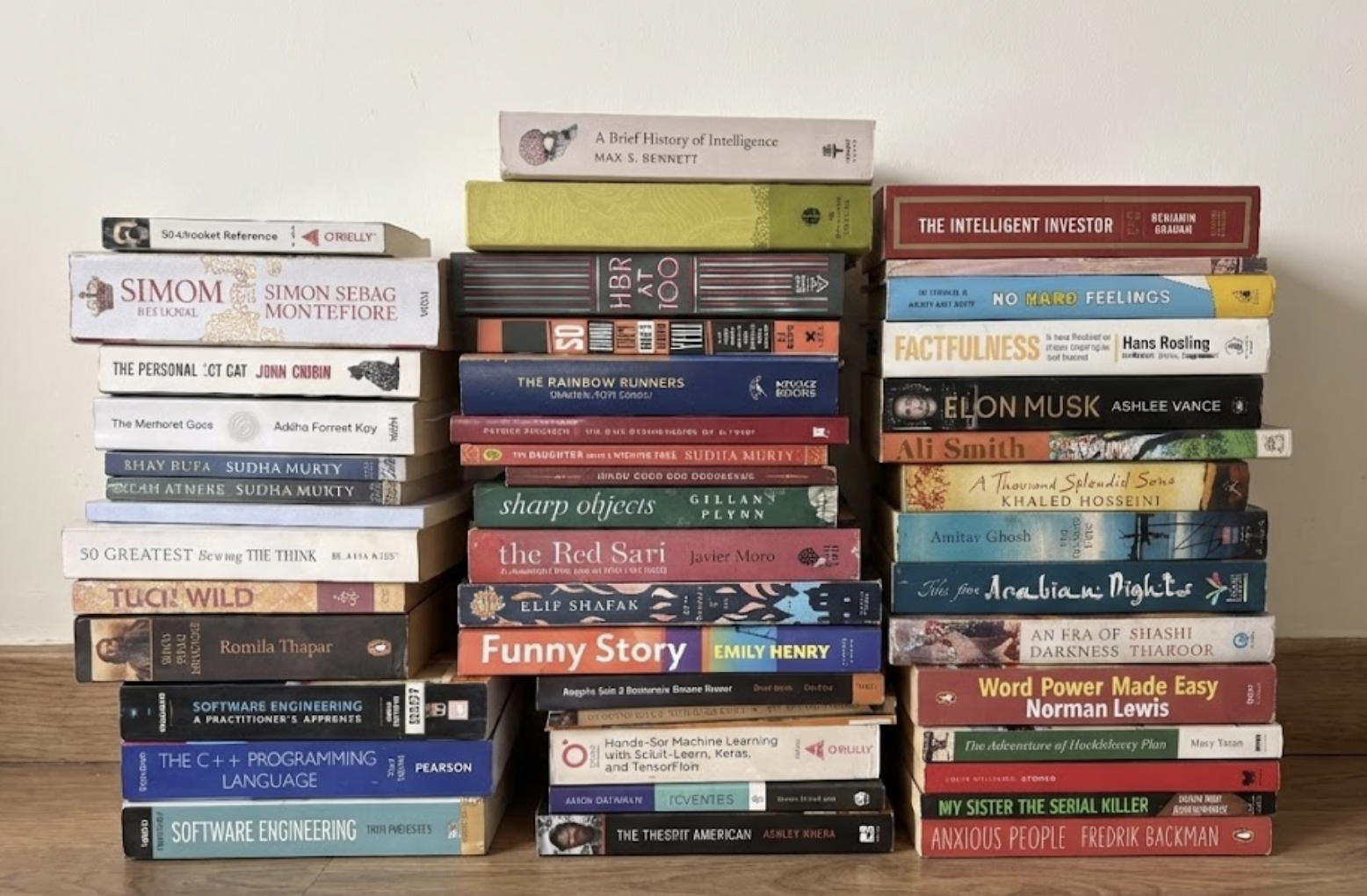
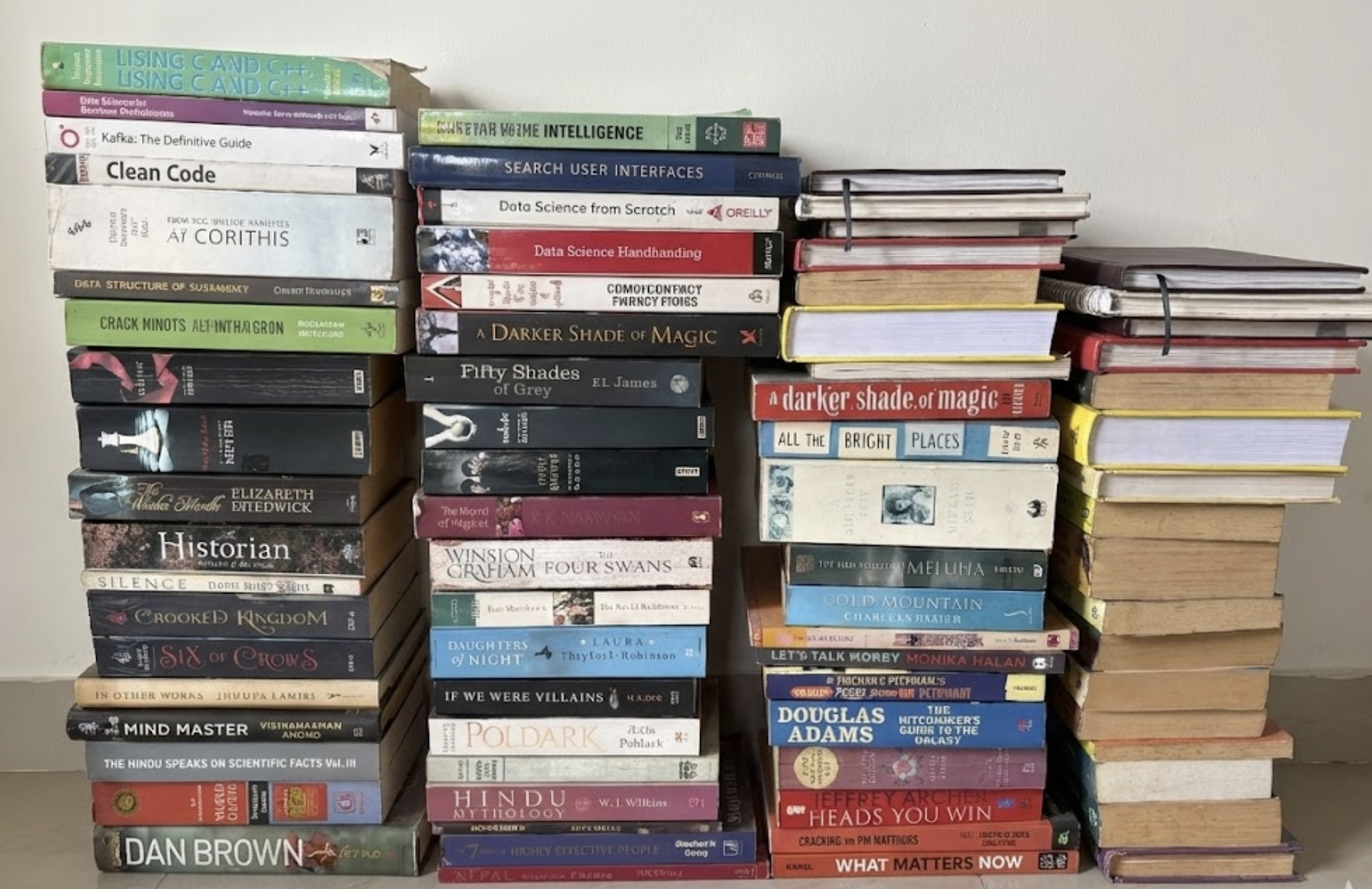
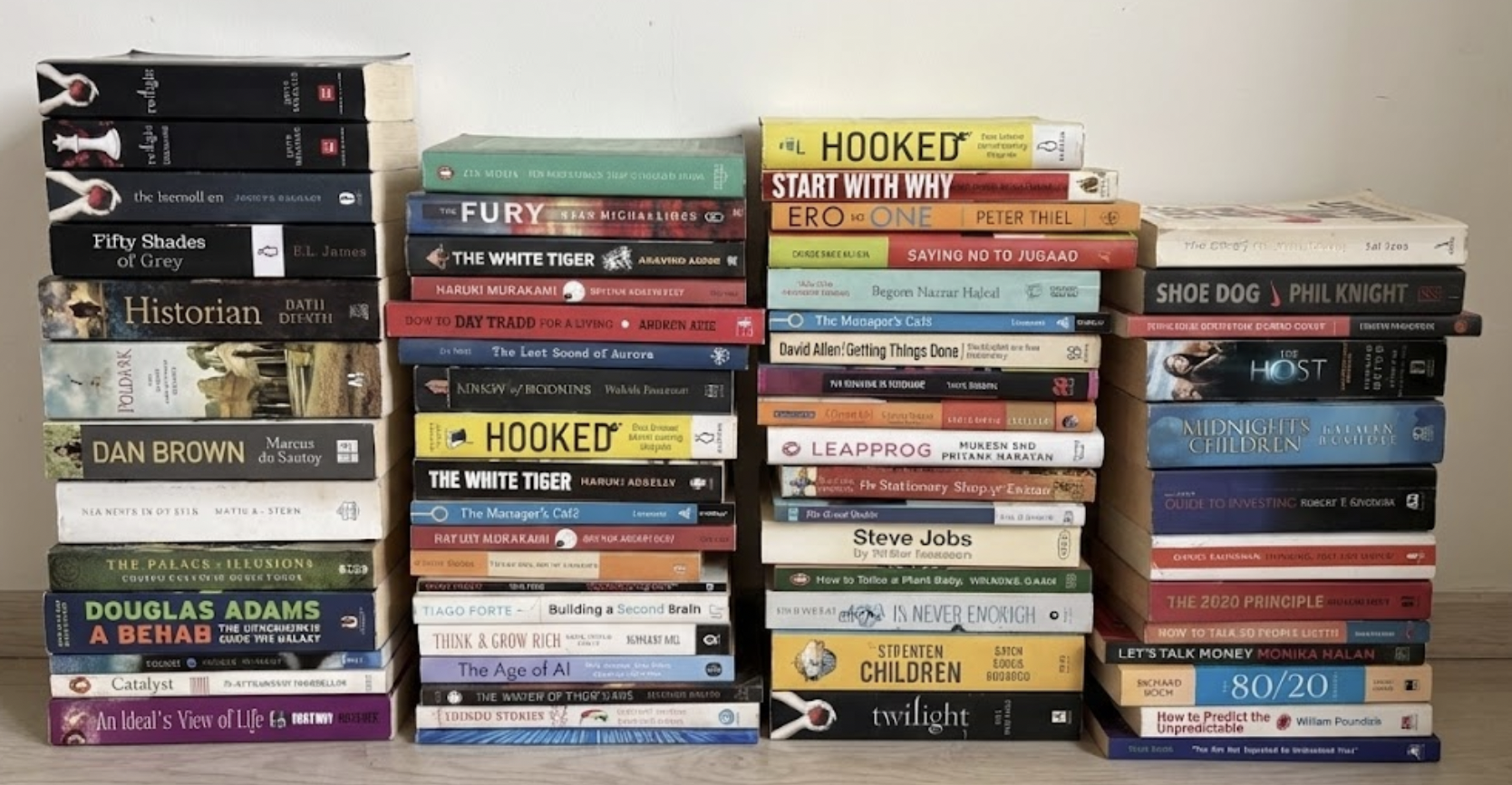
<p>Until last year, I based my reading list on Goodreads / Reddit recommendations and added some book covers that I loved! This year, I decided to pick most of them from my bookshelf. Looking at my bookshelf, I felt overwhelmed, so I used AI to make a book list.</p>

<p><b>Glimpses from My Bookshelves and Input to Gemini Pro</b></p>

<p><img src="/assets/images/Book_shelf.png" alt="Book Shelf View" width="150" height="250" />
<img src="/assets/images/Book_shelf_1.png" alt="Book Shelf View" width="150" height="250" />
<img src="/assets/images/Book_shelf_2.png" alt="Book Shelf View" width="150" height="250" />
<img src="/assets/images/Book_shelf_3.png" alt="Book Shelf View" width="150" height="250" /></p>

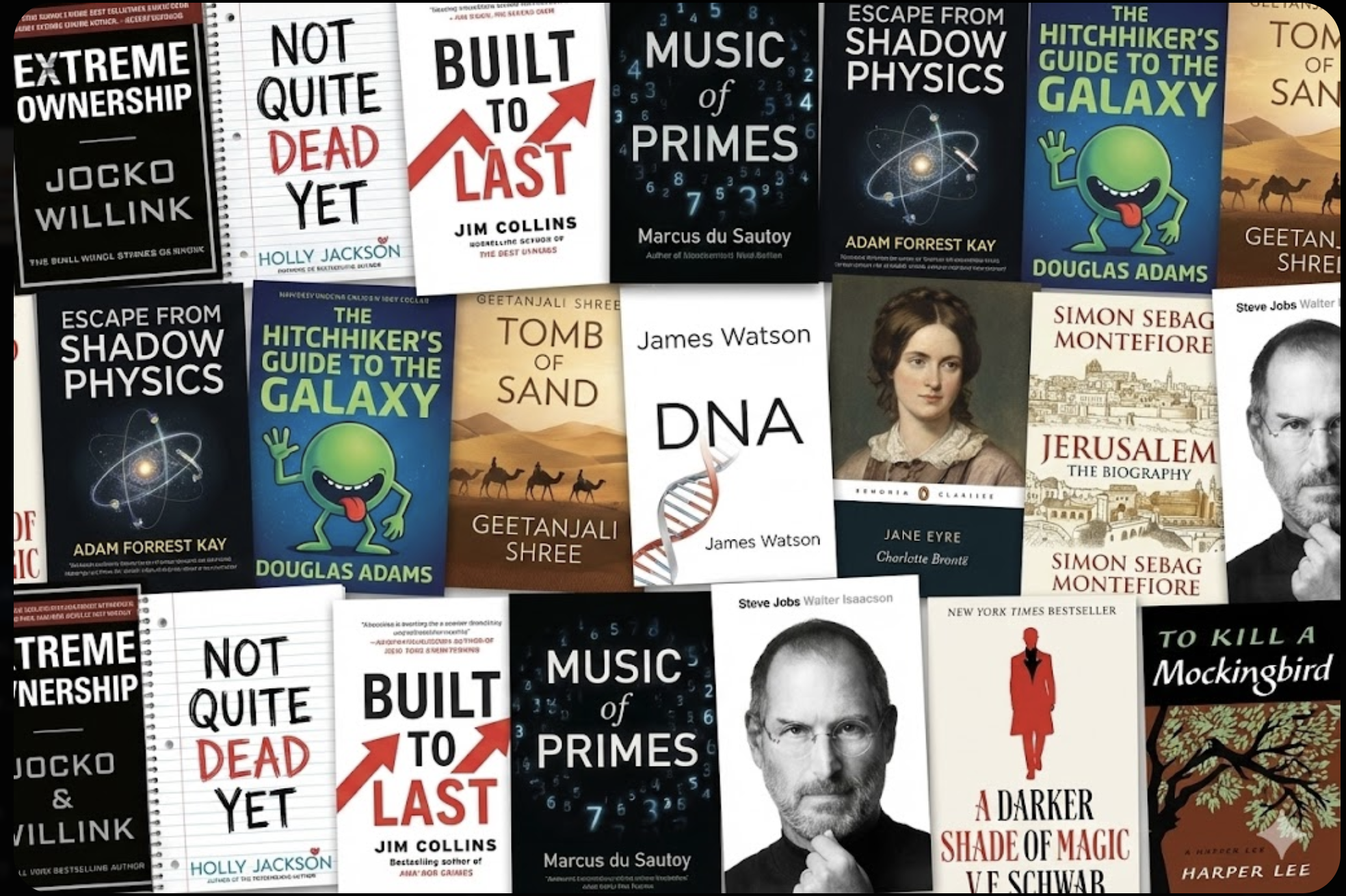
<p>Gemini did a pretty decent job of preparing a TBR for me. I threw in a few books that I had previously planned (or that were missing from the shelf), and here is the final list.</p>

<table>
  <thead>
    <tr>
      <th>Name</th>
      <th>Status</th>
      <th>Comments</th>
    </tr>
  </thead>
  <tbody>
    <tr>
      <td>Extreme Ownership by Jocko Willink &amp; Leif Babin</td>
      <td>Reading</td>
      <td>Recommended by @andrew. I have already started reading this; it is very gripping.</td>
    </tr>
    <tr>
      <td>Not Quite Dead Yet by Holly Jackson</td>
      <td>Reading</td>
      <td>AlphaSense Book Club Read. I have been missing out for quite some time, so it is time to catch up.</td>
    </tr>
    <tr>
      <td>Built to Last by Jim Collins</td>
      <td>Ready to Start</td>
      <td>This is the last pending book in the series, following Great by Choice and Good to Great. Recommended by Satish Khannan (CEO, MediBuddy).</td>
    </tr>
    <tr>
      <td>Music of Primes by Marcus du Sautoy</td>
      <td>Ready to Start</td>
      <td>Time for some fun with Math.</td>
    </tr>
    <tr>
      <td>Escape From Shadow Physics by Adam Forrest Kay</td>
      <td>Ready to Start</td>
      <td>And Physics, too!</td>
    </tr>
    <tr>
      <td>The Hitchhiker’s Guide to the Galaxy by Douglas Adams</td>
      <td>Ready to Start</td>
      <td>And the Galaxy!</td>
    </tr>
    <tr>
      <td>Tomb of Sand by Geetanjali Shree</td>
      <td>Ready to Start</td>
      <td>This International Booker Prize winner has been on my list for quite some time. The premise is gripping: a woman’s journey across the border to find her true self!</td>
    </tr>
    <tr>
      <td>DNA by James Watson</td>
      <td>Ready to Start</td>
      <td>Back to understanding what is happening in our brains!</td>
    </tr>
    <tr>
      <td>Jane Eyre by Charlotte Brontë</td>
      <td>Ready to Start</td>
      <td>Time for some classics!</td>
    </tr>
    <tr>
      <td>Jerusalem: The Biography by Simon Sebag Montefiore</td>
      <td>Ready to Start</td>
      <td>A city I have always been fascinated by. Religion, Politics, War—you name it, and this city has it all!</td>
    </tr>
    <tr>
      <td>Steve Jobs by Walter Isaacson</td>
      <td>Ready to Start</td>
      <td> </td>
    </tr>
    <tr>
      <td>A Darker Shade of Magic by V.E. Schwab</td>
      <td>Ready to Start</td>
      <td>A light read towards the end of the year.</td>
    </tr>
    <tr>
      <td>To Kill a Mockingbird by Harper Lee</td>
      <td>Ready to Start</td>
      <td>I want to end the year with this epic (a re-read for Christmas!).</td>
    </tr>
  </tbody>
</table>

<p><img src="/assets/images/tbr-2026.png" alt="TBR 2026" width="600" height="450" /></p>

<p>All the best for your 2026 reading goals! If you wish to follow along for my reviews / additional books, that I tend to add to this list; here is my notion page&lt;/a&gt;.</p>

<p>All the best for your 2026 reading goals! here is <a href="https://www.notion.so/koffeecuptales/Reading-List-2026-2d735890674480b7af0cdebf08973169?source=copy_link">Notion page</a>, where I keep track of my reading status and reviews.</p>

<p>Appendix I</p>

<blockquote>
  <p>List of all books on my shelves.</p>
</blockquote>

<table>
  <thead>
    <tr>
      <th>Book Name</th>
      <th>Author</th>
      <th>Genre</th>
    </tr>
  </thead>
  <tbody>
    <tr>
      <td>A Brief History of Intelligence</td>
      <td>Max S. Bennett</td>
      <td>Non-Fiction - Science/AI</td>
    </tr>
    <tr>
      <td>A Darker Shade of Magic</td>
      <td>V.E. Schwab</td>
      <td>Fiction - Fantasy</td>
    </tr>
    <tr>
      <td>A Suitable Boy</td>
      <td>Vikram Seth</td>
      <td>Fiction - Literary/Historical</td>
    </tr>
    <tr>
      <td>A Tale of Two Cities</td>
      <td>Charles Dickens</td>
      <td>Fiction - Classic</td>
    </tr>
    <tr>
      <td>A Thousand Splendid Suns</td>
      <td>Khaled Hosseini</td>
      <td>Fiction - Historical</td>
    </tr>
    <tr>
      <td>All the Bright Places</td>
      <td>Jennifer Niven</td>
      <td>Fiction - YA Contemporary</td>
    </tr>
    <tr>
      <td>An Era of Darkness</td>
      <td>Shashi Tharoor</td>
      <td>Non-Fiction - History</td>
    </tr>
    <tr>
      <td>Anxious People</td>
      <td>Fredrik Backman</td>
      <td>Fiction - Contemporary</td>
    </tr>
    <tr>
      <td>Apache Solr 3 Enterprise Search Server</td>
      <td>Various/Technical</td>
      <td>Non-Fiction - Tech/Software</td>
    </tr>
    <tr>
      <td>Attention Factory</td>
      <td>Matthew Brennan</td>
      <td>Non-Fiction - Business/Tech</td>
    </tr>
    <tr>
      <td>Attention Management</td>
      <td>Maura Nevel Thomas</td>
      <td>Non-Fiction - Productivity</td>
    </tr>
    <tr>
      <td>Autumn</td>
      <td>Ali Smith</td>
      <td>Fiction - Literary</td>
    </tr>
    <tr>
      <td>Breaking Dawn</td>
      <td>Stephenie Meyer</td>
      <td>Fiction - YA Fantasy</td>
    </tr>
    <tr>
      <td>Building a Second Brain</td>
      <td>Tiago Forte</td>
      <td>Non-Fiction - Productivity</td>
    </tr>
    <tr>
      <td>Clean Code</td>
      <td>Robert C. Martin</td>
      <td>Non-Fiction - Tech/Programming</td>
    </tr>
    <tr>
      <td>Cold Mountain</td>
      <td>Charles Frazier</td>
      <td>Fiction - Historical</td>
    </tr>
    <tr>
      <td>Crooked Kingdom</td>
      <td>Leigh Bardugo</td>
      <td>Fiction - YA Fantasy</td>
    </tr>
    <tr>
      <td>Dan Brown (Inferno)</td>
      <td>Dan Brown</td>
      <td>Fiction - Thriller</td>
    </tr>
    <tr>
      <td>Dare to Lead</td>
      <td>Brené Brown</td>
      <td>Non-Fiction - Leadership</td>
    </tr>
    <tr>
      <td>Data Science for Business Professionals</td>
      <td>Probyto</td>
      <td>Non-Fiction - Data Science</td>
    </tr>
    <tr>
      <td>Design as Art</td>
      <td>Bruno Munari</td>
      <td>Non-Fiction - Art/Design</td>
    </tr>
    <tr>
      <td>Eclipse</td>
      <td>Stephenie Meyer</td>
      <td>Fiction - YA Fantasy</td>
    </tr>
    <tr>
      <td>Elon Musk</td>
      <td>Ashlee Vance</td>
      <td>Non-Fiction - Biography</td>
    </tr>
    <tr>
      <td>Factfulness</td>
      <td>Hans Rosling</td>
      <td>Non-Fiction - Statistics/Society</td>
    </tr>
    <tr>
      <td>Fifty Shades of Grey</td>
      <td>E.L. James</td>
      <td>Fiction - Romance</td>
    </tr>
    <tr>
      <td>Funny Story</td>
      <td>Emily Henry</td>
      <td>Fiction - Romance</td>
    </tr>
    <tr>
      <td>Getting Things Done</td>
      <td>David Allen</td>
      <td>Non-Fiction - Productivity</td>
    </tr>
    <tr>
      <td>Guide to Investing</td>
      <td>Robert T. Kiyosaki</td>
      <td>Non-Fiction - Finance</td>
    </tr>
    <tr>
      <td>Hands-On Machine Learning…</td>
      <td>Aurélien Géron</td>
      <td>Non-Fiction - Data Science</td>
    </tr>
    <tr>
      <td>HBR at 100</td>
      <td>Harvard Business Review</td>
      <td>Non-Fiction - Business</td>
    </tr>
    <tr>
      <td>Heads You Win</td>
      <td>Jeffrey Archer</td>
      <td>Fiction - Thriller</td>
    </tr>
    <tr>
      <td>Hooked</td>
      <td>Nir Eyal</td>
      <td>Non-Fiction - Product Design</td>
    </tr>
    <tr>
      <td>How to Day Trade for a Living</td>
      <td>Andrew Aziz</td>
      <td>Non-Fiction - Finance</td>
    </tr>
    <tr>
      <td>How to Predict the Unpredictable</td>
      <td>William Poundstone</td>
      <td>Non-Fiction - Science/Math</td>
    </tr>
    <tr>
      <td>How to Talk So People Listen</td>
      <td>Sonya Hamlin</td>
      <td>Non-Fiction - Communication</td>
    </tr>
    <tr>
      <td>Introduction to Algorithms</td>
      <td>Cormen et al.</td>
      <td>Non-Fiction - Computer Science</td>
    </tr>
    <tr>
      <td>Jane Eyre</td>
      <td>Charlotte Brontë</td>
      <td>Fiction - Classic</td>
    </tr>
    <tr>
      <td>Java: The Complete Reference</td>
      <td>Herbert Schildt</td>
      <td>Non-Fiction - Programming</td>
    </tr>
    <tr>
      <td>Kafka: The Definitive Guide</td>
      <td>Gwen Shapira et al.</td>
      <td>Non-Fiction - Tech/Software</td>
    </tr>
    <tr>
      <td>Learn Kannada Through Telugu</td>
      <td>Unknown</td>
      <td>Non-Fiction - Language</td>
    </tr>
    <tr>
      <td>Let’s Talk Money</td>
      <td>Monika Halan</td>
      <td>Non-Fiction - Personal Finance</td>
    </tr>
    <tr>
      <td>Manager’s Handbook</td>
      <td>Harvard Business Review</td>
      <td>Non-Fiction - Management</td>
    </tr>
    <tr>
      <td>Midnight’s Children</td>
      <td>Salman Rushdie</td>
      <td>Fiction - Magical Realism</td>
    </tr>
    <tr>
      <td>Mind Master</td>
      <td>Viswanathan Anand</td>
      <td>Non-Fiction - Memoir/Sports</td>
    </tr>
    <tr>
      <td>Mindset</td>
      <td>Carol S. Dweck</td>
      <td>Non-Fiction - Psychology</td>
    </tr>
    <tr>
      <td>My Sister, The Serial Killer</td>
      <td>Oyinkan Braithwaite</td>
      <td>Fiction - Satire/Thriller</td>
    </tr>
    <tr>
      <td>New Moon</td>
      <td>Stephenie Meyer</td>
      <td>Fiction - YA Fantasy</td>
    </tr>
    <tr>
      <td>No Hard Feelings</td>
      <td>Liz Fosslien &amp; Mollie West Duffy</td>
      <td>Non-Fiction - Business/Psych</td>
    </tr>
    <tr>
      <td>Palpasa Cafe</td>
      <td>Narayan Wagle</td>
      <td>Fiction - Contemporary</td>
    </tr>
    <tr>
      <td>Poldark</td>
      <td>Winston Graham</td>
      <td>Fiction - Historical</td>
    </tr>
    <tr>
      <td>Sharp Objects</td>
      <td>Gillian Flynn</td>
      <td>Fiction - Thriller</td>
    </tr>
    <tr>
      <td>Shoe Dog</td>
      <td>Phil Knight</td>
      <td>Non-Fiction - Memoir/Business</td>
    </tr>
    <tr>
      <td>Six of Crows</td>
      <td>Leigh Bardugo</td>
      <td>Fiction - YA Fantasy</td>
    </tr>
    <tr>
      <td>So Good They Can’t Ignore You</td>
      <td>Cal Newport</td>
      <td>Non-Fiction - Career/Self-Help</td>
    </tr>
    <tr>
      <td>Software Engineering</td>
      <td>Ian Sommerville</td>
      <td>Non-Fiction - Tech/Textbook</td>
    </tr>
    <tr>
      <td>Software Engineering: A Practitioner’s Approach</td>
      <td>Roger Pressman</td>
      <td>Non-Fiction - Tech/Textbook</td>
    </tr>
    <tr>
      <td>Start with Why</td>
      <td>Simon Sinek</td>
      <td>Non-Fiction - Leadership</td>
    </tr>
    <tr>
      <td>Steve Jobs</td>
      <td>Walter Isaacson</td>
      <td>Non-Fiction - Biography</td>
    </tr>
    <tr>
      <td>Surely You’re Joking, Mr. Feynman!</td>
      <td>Richard P. Feynman</td>
      <td>Non-Fiction - Memoir/Science</td>
    </tr>
    <tr>
      <td>Tales from Arabian Nights</td>
      <td>Various</td>
      <td>Fiction - Folklore/Classic</td>
    </tr>
    <tr>
      <td>The 7 Habits of Highly Effective People</td>
      <td>Stephen R. Covey</td>
      <td>Non-Fiction - Self-Help</td>
    </tr>
    <tr>
      <td>The 80/20 Principle</td>
      <td>Richard Koch</td>
      <td>Non-Fiction - Business</td>
    </tr>
    <tr>
      <td>The Adventures of Huckleberry Finn</td>
      <td>Mark Twain</td>
      <td>Fiction - Classic</td>
    </tr>
    <tr>
      <td>The Age of AI</td>
      <td>Kissinger, Schmidt, Huttenlocher</td>
      <td>Non-Fiction - Tech/Society</td>
    </tr>
    <tr>
      <td>The C++ Programming Language</td>
      <td>Bjarne Stroustrup</td>
      <td>Non-Fiction - Programming</td>
    </tr>
    <tr>
      <td>The Daily Stoic</td>
      <td>Ryan Holiday</td>
      <td>Non-Fiction - Philosophy</td>
    </tr>
    <tr>
      <td>The Daughter from a Wishing Tree</td>
      <td>Sudha Murty</td>
      <td>Fiction - Mythology</td>
    </tr>
    <tr>
      <td>The Everything Store</td>
      <td>Brad Stone</td>
      <td>Non-Fiction - Business</td>
    </tr>
    <tr>
      <td>The Five Dysfunctions of a Team</td>
      <td>Patrick Lencioni</td>
      <td>Non-Fiction - Business Fable</td>
    </tr>
    <tr>
      <td>The Fury</td>
      <td>Alex Michaelides</td>
      <td>Fiction - Thriller</td>
    </tr>
    <tr>
      <td>The Girl on the Train</td>
      <td>Paula Hawkins</td>
      <td>Fiction - Thriller</td>
    </tr>
    <tr>
      <td>The God of Small Things</td>
      <td>Arundhati Roy</td>
      <td>Fiction - Literary</td>
    </tr>
    <tr>
      <td>The Historian</td>
      <td>Elizabeth Kostova</td>
      <td>Fiction - Historical/Horror</td>
    </tr>
    <tr>
      <td>The Hitchhiker’s Guide to the Galaxy</td>
      <td>Douglas Adams</td>
      <td>Fiction - Sci-Fi</td>
    </tr>
    <tr>
      <td>The Host</td>
      <td>Stephenie Meyer</td>
      <td>Fiction - Sci-Fi/Romance</td>
    </tr>
    <tr>
      <td>The Hungry Tide</td>
      <td>Amitav Ghosh</td>
      <td>Fiction - Historical</td>
    </tr>
    <tr>
      <td>The Immortals of Meluha</td>
      <td>Amish Tripathi</td>
      <td>Fiction - Mythology</td>
    </tr>
    <tr>
      <td>The Innovators</td>
      <td>Walter Isaacson</td>
      <td>Non-Fiction - Tech History</td>
    </tr>
    <tr>
      <td>The Intelligent Investor</td>
      <td>Benjamin Graham</td>
      <td>Non-Fiction - Investing</td>
    </tr>
    <tr>
      <td>The Palace of Illusions</td>
      <td>Chitra Banerjee Divakaruni</td>
      <td>Fiction - Mythology Retelling</td>
    </tr>
    <tr>
      <td>The Personal MBA</td>
      <td>Josh Kaufman</td>
      <td>Non-Fiction - Business</td>
    </tr>
    <tr>
      <td>The Rainbow Runners</td>
      <td>Dhrubajyoti Borah</td>
      <td>Fiction - Contemporary</td>
    </tr>
    <tr>
      <td>The Red Sari</td>
      <td>Javier Moro</td>
      <td>Non-Fiction - Biography</td>
    </tr>
    <tr>
      <td>The Theory of Everything</td>
      <td>Stephen Hawking</td>
      <td>Non-Fiction - Science</td>
    </tr>
    <tr>
      <td>The White Tiger</td>
      <td>Aravind Adiga</td>
      <td>Fiction - Literary/Satire</td>
    </tr>
    <tr>
      <td>The Winter Mantle</td>
      <td>Elizabeth Chadwick</td>
      <td>Fiction - Historical</td>
    </tr>
    <tr>
      <td>The World of Malgudi</td>
      <td>R.K. Narayan</td>
      <td>Fiction - Short Stories</td>
    </tr>
    <tr>
      <td>Think &amp; Grow Rich</td>
      <td>Napoleon Hill</td>
      <td>Non-Fiction - Self-Help</td>
    </tr>
    <tr>
      <td>Thinking, Fast and Slow</td>
      <td>Daniel Kahneman</td>
      <td>Non-Fiction - Psychology</td>
    </tr>
    <tr>
      <td>Twilight</td>
      <td>Stephenie Meyer</td>
      <td>Fiction - YA Fantasy</td>
    </tr>
    <tr>
      <td>Unconventionals</td>
      <td>O’Toole</td>
      <td>Non-Fiction - Business</td>
    </tr>
    <tr>
      <td>Using C and C++</td>
      <td>Various</td>
      <td>Non-Fiction - Programming</td>
    </tr>
    <tr>
      <td>What Matters Now</td>
      <td>Gary Hamel</td>
      <td>Non-Fiction - Business</td>
    </tr>
    <tr>
      <td>Why does E=mc2?</td>
      <td>Brian Cox</td>
      <td>Non-Fiction - Science</td>
    </tr>
    <tr>
      <td>Word Power Made Easy</td>
      <td>Norman Lewis</td>
      <td>Non-Fiction - Education</td>
    </tr>
    <tr>
      <td>You Are Not Expected to Understand This</td>
      <td>Torie Bosch</td>
      <td>Non-Fiction - Tech History</td>
    </tr>
    <tr>
      <td>You Can Achieve More</td>
      <td>Shiv Khera</td>
      <td>Non-Fiction - Self-Help</td>
    </tr>
    <tr>
      <td>Zero to One</td>
      <td>Peter Thiel</td>
      <td>Non-Fiction - Business/Startups</td>
    </tr>
  </tbody>
</table>]]></content><author><name></name></author><category term="books" /><category term="2026" /><category term="tbr" /><category term="goals" /><summary type="html"><![CDATA[Every year, as a tradition, I create a TBR list (To Be Read). Last year, even though life took me for a ride, this list helped me come back and turn some pages here and there. Here’s last year’s list, if you’re interested — here.]]></summary></entry><entry><title type="html">Ocean Wave Simulation | GPT-5.2 vs Gemini-3.0-Pro</title><link href="https://krishnaclouds.github.io/2025/12/12/ocean-wave-simulation-copy/" rel="alternate" type="text/html" title="Ocean Wave Simulation | GPT-5.2 vs Gemini-3.0-Pro" /><published>2025-12-12T00:00:00+00:00</published><updated>2025-12-12T00:00:00+00:00</updated><id>https://krishnaclouds.github.io/2025/12/12/ocean-wave-simulation%20copy</id><content type="html" xml:base="https://krishnaclouds.github.io/2025/12/12/ocean-wave-simulation-copy/"><![CDATA[<p>OpenAI released the GPT-5.2 Thinking model today and, interestingly, in their <a href="https://openai.com/index/introducing-gpt-5-2/">blog post</a> they mentioned the model excels at Excel tasks, PPT generation, and working with 3D elements.</p>

<p>OpenAI also included a short prompt to generate an Ocean Wave Simulation, along with the result. Here, I run the same prompt across three models — and GPT-5.2 didn’t fare well.</p>

<h2 id="models-tested">Models tested</h2>

<ol>
  <li>GPT-5.2 itself (via Cursor Agent)</li>
  <li>Gemini 3.0 Pro (Beta) — enabled for Enterprise customers</li>
  <li>Gemini 3.0 Pro — enabled for the general public</li>
</ol>

<h2 id="verdict">Verdict</h2>

<ol>
  <li>Overall, Gemini 3.0 Pro (general model) did a better job: it generated the output in one shot and has 3D depth.</li>
  <li>GPT-5.2 messed up the CSS even after multiple follow-up prompts.</li>
</ol>

<h2 id="screenshot-from-openai-blog-post">Screenshot from OpenAI blog post</h2>

<p>Source: <a href="https://openai.com/index/introducing-gpt-5-2/">Introducing GPT-5.2</a></p>

<div style="border: 1px solid rgba(255,255,255,0.12); border-radius: 12px; overflow: hidden; background: #0b1220; margin: 16px 0 22px 0;">
  <img alt="Ocean Wave Simulation screenshot from OpenAI Blog Post" src="/assets/images/ocean-wave-simulation.png" style="width: 100%; height: auto; display: block;" loading="lazy" />
</div>

<h2 id="gpt-52-thinking">GPT-5.2 Thinking</h2>

<div style="border: 1px solid rgba(255,255,255,0.12); border-radius: 12px; overflow: hidden; background: #0b1220;">
  <iframe title="Ocean Wave Simulation generated using GPT-5.2" src="/assets/demos/ocean-wave-simulation.html" style="width: 100%; height: 650px; border: 0; display: block;" loading="lazy" referrerpolicy="no-referrer"></iframe>
</div>

<h2 id="gemini-30-pro-beta-thinking-enterprise">Gemini-3.0 Pro (Beta) Thinking Enterprise</h2>

<div style="border: 1px solid rgba(255,255,255,0.12); border-radius: 12px; overflow: hidden; background: #0b1220;">
  <iframe title="Ocean Wave Simulation generated using Gemini 3.0 Pro (Beta) Thinking Model enabled for Enterprise Customers" src="/assets/demos/gemini-3-0-enterprise.html" style="width: 100%; height: 650px; border: 0; display: block;" loading="lazy" referrerpolicy="no-referrer"></iframe>
</div>

<h2 id="gemini-30-pro-thinking">Gemini-3.0 Pro (Thinking)</h2>

<div style="border: 1px solid rgba(255,255,255,0.12); border-radius: 12px; overflow: hidden; background: #0b1220;">
  <iframe title="Ocean Wave Simulation generated using Gemini 3.0 Thinking enabled for General Public" src="/assets/demos/gemini-pro-3-0-thinking.html" style="width: 100%; height: 650px; border: 0; display: block;" loading="lazy" referrerpolicy="no-referrer"></iframe>
</div>]]></content><author><name></name></author><category term="webgl" /><category term="shaders" /><category term="simulation" /><category term="graphics" /><summary type="html"><![CDATA[OpenAI released the GPT-5.2 Thinking model today and, interestingly, in their blog post they mentioned the model excels at Excel tasks, PPT generation, and working with 3D elements.]]></summary></entry><entry><title type="html">GraphRAG - Is it worth It? (Absolutely!)</title><link href="https://krishnaclouds.github.io/2025/08/05/graphrag-is-it-worth-it/" rel="alternate" type="text/html" title="GraphRAG - Is it worth It? (Absolutely!)" /><published>2025-08-05T12:00:00+00:00</published><updated>2025-08-05T12:00:00+00:00</updated><id>https://krishnaclouds.github.io/2025/08/05/graphrag-is-it-worth-it</id><content type="html" xml:base="https://krishnaclouds.github.io/2025/08/05/graphrag-is-it-worth-it/"><![CDATA[<h1 id="graphrag---is-it-worth-it-absolutely">GraphRAG - Is it worth It? (Absolutely!)</h1>
<h2 id="putting-graphrag-to-test-knowing-its-worth-and-when-to-deploy-it">Putting GraphRAG to test, knowing it’s worth and when to deploy it!</h2>

<p>The battle between knowledge graphs and vector databases just got real. Here’s what 160 queries and rigorous evaluation revealed about the future of AI-powered search.</p>

<hr />

<h2 id="the-information-retrieval-revolution-we-didnt-see-coming">The Information Retrieval Revolution We Didn’t See Coming</h2>

<p>Imagine asking an AI system: “What are the connections between reinforcement learning and robotics?”</p>

<p>A traditional RAG system might give you a decent answer based on document similarity. But what if that same system could understand that DeepMind’s research team led by David Silver worked on both AlphaGo (reinforcement learning) and later collaborated with Boston Dynamics on robotic applications, creating a web of knowledge that goes far beyond simple document matching?</p>

<p>That’s the promise of GraphRAG—and after putting it through the most rigorous evaluation I’ve ever conducted, I can tell you: <strong>We can’t ignore GraphRAG</strong>.</p>

<h2 id="what-is-graphrag-really">What Is GraphRAG, Really?</h2>

<p>Before diving into the data, let’s establish what we’re talking about. Traditional RAG (Retrieval-Augmented Generation) works like this:</p>

<ol>
  <li>
    <p>Document Chunking: Break documents into pieces</p>
  </li>
  <li>
    <p>Vector Embedding: Convert text to numerical representations</p>
  </li>
  <li>
    <p>Similarity Search: Find chunks most similar to your query</p>
  </li>
  <li>
    <p>Generation: Feed retrieved chunks to an LLM for synthesis</p>
  </li>
</ol>

<p><strong>GraphRAG takes this foundation and adds a crucial layer:</strong></p>

<ol>
  <li>
    <p><strong>Knowledge Graph Construction</strong>: Extract entities, relationships, and concepts (although Microsoft’s original paper proposes to use LLMs, I wonder, why can’t we just use simple NER?!)</p>
  </li>
  <li>
    <p><strong>Entity Linking</strong>: Connect related entities across documents</p>
  </li>
  <li>
    <p><strong>Graph-Enhanced Retrieval</strong>: Use both vector similarity AND graph relationships</p>
  </li>
  <li>
    <p><strong>Multi-hop Reasoning</strong>: Traverse connections to find non-obvious insights (This is what we need to test!!)</p>
  </li>
</ol>

<p>Think of it as the difference between a library catalog (traditional RAG) and a research assistant who knows how every book, author, and concept connects to every other (GraphRAG).</p>

<blockquote>
  <p><strong>P.S.</strong> Got this analogy from LLM (Gemini Pro 2.5)</p>
</blockquote>

<h2 id="the-experiment-160-queries-zero-bias">The Experiment: 160 Queries, Zero Bias</h2>

<p><em>We use LLM as a judge and it has the context of only query and the summary LLM generated</em></p>

<h3 id="the-dataset-1000-documents-from-diverse-sources">The Dataset: 1,000+ documents from diverse sources</h3>

<ul>
  <li><strong>550+</strong> research papers from ArXiv and Semantic Scholar</li>
  <li><strong>250+</strong> tech news articles from TechCrunch, VentureBeat, Wired</li>
  <li><strong>200+</strong> GitHub repositories with AI/ML focus</li>
  <li><strong>500+</strong> entities in our knowledge graph with rich interconnections</li>
</ul>

<h3 id="the-evaluation-framework">The Evaluation Framework</h3>

<ul>
  <li><strong>160</strong> carefully crafted queries across 8 categories</li>
  <li><strong>Blind LLM judge evaluation</strong> (Claude 3.5 Sonnet)</li>
  <li><strong>6 evaluation criteria</strong>: Completeness, Accuracy, Contextual Depth, Clarity, Relevance, Actionable Insights</li>
</ul>

<p><em>Note: I added this to improve the data-set and queries. I used O3-mini for first 10-15 trials and then switched to Claude 3.5 as a judge</em></p>

<h3 id="the-categories-tested">The Categories Tested</h3>

<ol>
  <li><strong>AI/ML Research</strong> - “Latest advances in transformer architectures”</li>
  <li><strong>Technical Deep Dive</strong> - “How does gradient descent optimization work?”</li>
  <li><strong>Industry Applications</strong> - “How are companies using federated learning?”</li>
  <li><strong>Comparative Analysis</strong> - “GraphRAG vs traditional RAG differences”</li>
  <li><strong>Future Directions</strong> - “What’s next for multimodal AI?”</li>
  <li><strong>Company Technology</strong> - “What AI research is Google focusing on?”</li>
  <li><strong>Cross Domain Connections</strong> - “Relationship between NLP and computer vision”</li>
  <li><strong>Research Trends</strong> - “Who are the key researchers in reinforcement learning?”</li>
</ol>

<h3 id="decoding-the-results">Decoding the Results</h3>

<p><em>My initial thought was to use — (em-dash) instead of : (colon) in the above heading; side effects of using LLM too much!</em></p>

<p>These aren’t marginal improvements. These seemed consistent and assertive (at least for the experiment setup we did!)</p>

<h4 id="where-graphrag-absolutely-dominates">Where GraphRAG Absolutely Dominates</h4>

<p>The category breakdown reveals where GraphRAG excels:</p>

<h4 id="the-criteria-that-matter-most">The Criteria That Matter Most</h4>

<p>Breaking down performance by evaluation criteria:</p>

<blockquote>
  <p><strong>P.S.</strong> Note how traditional RAG always scores 7.5 (I felt it is a code bug somehow the summary of RAG systems always averaged out to 7.5. Will be triggering a few more tests to understand this behavior. Expect a part 2 of the article!)</p>
</blockquote>

<p>Notice something interesting? GraphRAG doesn’t just win on technical metrics—it provides more relevant, actionable, and complete answers. This stems from the number of documents it was able to retrieve.</p>

<h4 id="judge-confidence-the-trust-factor">Judge Confidence: The Trust Factor</h4>

<p>Perhaps most importantly, the AI judge was confident in its decisions:</p>

<ul>
  <li><strong>45.6%</strong> of decisions made with high confidence (&gt;80%)</li>
  <li><strong>54.4%</strong> of decisions made with medium confidence (60-80%)</li>
  <li><strong>0%</strong> low confidence decisions</li>
  <li><strong>Average confidence</strong>: 78.2%</li>
</ul>

<p>This isn’t just statistical noise—these are clear, reliable quality differences.</p>

<h3 id="sample-query-and-the-difference">Sample Query and The Difference</h3>

<p><strong>Query</strong>: “What researchers are working on BERT and transformer models?”</p>

<h4 id="traditional-rag-response">Traditional RAG Response:</h4>

<blockquote>
  <p>“BERT was developed by Google AI researchers including Jacob Devlin, Ming-Wei Chang, Kenton Lee, and Kristina Toutanova. The transformer architecture was introduced by Vaswani et al. in ‘Attention Is All You Need’…”</p>
</blockquote>

<h4 id="graphrag-response">GraphRAG Response:</h4>

<blockquote>
  <p>“The BERT and transformer research landscape involves several key researchers and institutions:</p>
</blockquote>

<p><strong>Google AI Team</strong>: Jacob Devlin (lead BERT researcher), Ming-Wei Chang, Kenton Lee, and Kristina Toutanova developed BERT. They built on transformer work by Ashish Vaswani, Noam Shazeer, and others.</p>

<p><strong>Academic Collaborations</strong>: The original transformer paper came from Google Brain and Google Research, with contributions from University of Toronto (Aidan Gomez) and others.</p>

<p><strong>Follow-up Research</strong>: Tom Brown (OpenAI) led GPT development, while Luke Zettlemoyer (University of Washington/Meta) worked on RoBERTa improvements.</p>

<p><strong>Current Developments</strong>: Researchers like Colin Raffel (UNC/Google) are exploring T5 and unified text-to-text transformers, while Yann LeCun’s team at Meta investigates self-supervised learning applications…”</p>

<p><strong>The Difference</strong>: GraphRAG understands that researchers move between institutions, collaborate across organizations, and that understanding these relationships provides much richer context.</p>

<h2 id="performance-considerations">Performance Considerations</h2>

<ul>
  <li><strong>Query Latency</strong>: GraphRAG adds ~200ms overhead for graph traversal</li>
  <li><strong>Storage</strong>: Knowledge graph requires ~2GB for 1000 documents <em>(I could have optimized this with a few code tweaks)</em></li>
  <li><strong>Accuracy</strong>: 7.62/10 vs 7.5/10 (minimal difference in factual accuracy)</li>
  <li><strong>Completeness</strong>: 8.46/10 vs 7.5/10 (significant improvement in comprehensiveness)</li>
</ul>

<h2 id="when-graphrag-fails-and-why-that-matters">When GraphRAG Fails (And Why That Matters)</h2>

<p><em>These are some limitations I have identified (not comprehensive though!)</em></p>

<h3 id="where-traditional-rag-still-competes">Where Traditional RAG Still Competes</h3>

<h4 id="1-simple-factual-queries">1. Simple Factual Queries</h4>
<p><strong>Example</strong>: “What is the capital of France?”</p>
<ul>
  <li><strong>Traditional RAG</strong>: Fast, direct, accurate</li>
  <li><strong>GraphRAG</strong>: Overkill with similar results</li>
</ul>

<h4 id="2-highly-technical-deep-dives">2. Highly Technical Deep Dives</h4>
<p><strong>Example</strong>: “Explain back propagation mathematics”</p>
<ul>
  <li><strong>Traditional RAG</strong>: Focused, detailed technical content</li>
  <li><strong>GraphRAG</strong>: May add unnecessary context</li>
</ul>

<h4 id="3-single-document-answers">3. Single-Document Answers</h4>
<p><strong>When</strong>: The answer lives in one specific document</p>
<ul>
  <li><strong>Traditional RAG</strong>: Efficient document retrieval</li>
  <li><strong>GraphRAG</strong>: Graph overhead without benefit</li>
</ul>

<h3 id="the-trade-offs">The Trade-offs</h3>

<h2 id="the-future-of-rag-whats-next">The Future of RAG: What’s Next?</h2>

<p>Based on these results, here’s where I see the field heading:</p>

<h3 id="hybrid-approaches-will-dominate">Hybrid Approaches Will Dominate</h3>

<p>The future isn’t GraphRAG vs Traditional RAG—it’s intelligent routing:</p>

<ul>
  <li><strong>Simple queries</strong> → Traditional RAG</li>
  <li><strong>Complex relationship queries</strong> → GraphRAG</li>
  <li><strong>Mixed complexity</strong> → Hybrid approach</li>
</ul>

<h3 id="dynamic-knowledge-graph-construction">Dynamic Knowledge Graph Construction</h3>

<p>Current GraphRAG requires manual graph construction. Next-generation systems will:</p>

<ul>
  <li>Auto-generate knowledge graphs from documents</li>
  <li>Update graphs in real-time as new information arrives</li>
  <li>Learn optimal graph structures for specific domains</li>
</ul>

<h3 id="multi-modal-knowledge-graphs">Multi-Modal Knowledge Graphs</h3>

<h3 id="specialized-domain-graphs">Specialized Domain Graphs</h3>

<h2 id="the-bottom-line">The Bottom Line</h2>

<p>GraphRAG isn’t just an incremental improvement—it’s a paradigm shift toward AI systems that understand relationships and context the way humans do. The 36% performance advantage we measured is just the beginning. <em>(Results can vary based on data-set but consider it a win for this data-set at least!)</em></p>

<p>As knowledge graphs become easier to construct and maintain, and as AI systems become better at understanding relationships, GraphRAG will become the standard for any application requiring deep, contextual understanding.</p>

<p>The question isn’t whether GraphRAG is better than traditional RAG—our data proves it is for complex queries. The question is: <strong>Are you ready to implement it?</strong></p>

<blockquote>
  <p><strong>The Full Code, Dataset, Queries and Evaluations are available here in the GitHub repository</strong></p>
</blockquote>

<p>The future of information retrieval is relationship-aware, contextually rich, and powered by knowledge graphs. The question is: when will you make the jump?</p>

<hr />

<p><em>Thanks for reading Not So Random Blog! Subscribe for free to receive new posts and support my work.</em></p>]]></content><author><name></name></author><category term="AI" /><category term="GraphRAG" /><category term="RAG" /><summary type="html"><![CDATA[GraphRAG - Is it worth It? (Absolutely!) Putting GraphRAG to test, knowing it’s worth and when to deploy it!]]></summary></entry><entry><title type="html">The Daily Glance</title><link href="https://krishnaclouds.github.io/2024/06/22/the-daily-glance/" rel="alternate" type="text/html" title="The Daily Glance" /><published>2024-06-22T10:11:00+00:00</published><updated>2024-06-22T10:11:00+00:00</updated><id>https://krishnaclouds.github.io/2024/06/22/the-daily-glance</id><content type="html" xml:base="https://krishnaclouds.github.io/2024/06/22/the-daily-glance/"><![CDATA[<p><img src="/images/fan.jpg" alt="Fan" /></p>

<p>On a humid day, a seemingly simple yet deeply intricate image emerges. Crafted by an object we all turn to for solace - a fan or perhaps a simple window-adorned with a warm blanket, it stands as a silent sentinel against the oppressive heat.</p>

<p>The shadows it casts tell a different tale, woven by the reflections of nearby windows, the draping pants hanging from the balcony, and the gentle tinkling of decorative bells.</p>

<h2 id="the-extraordinary-in-the-ordinary">The Extraordinary in the Ordinary</h2>

<p>Is there anything special about this scene? At first glance, perhaps not. Yet, like the quiet narratives Amitav Ghosh unearths, it holds within it a tapestry of stories. Each shadow, each reflection, is a whisper of a moment passed.</p>

<p>The blanket, a silent witness to nights seeking peaceful sleep, carries the hopes of beautiful dreams. In this still life, the mundane becomes magical, a testament to the unseen layers of everyday existence.</p>

<p>Sometimes the most profound stories are found not in grand gestures, but in these quiet daily glances that surround us - if only we pause long enough to truly see them.</p>]]></content><author><name></name></author><category term="reflection" /><category term="photography" /><category term="everyday-life" /><category term="storytelling" /><summary type="html"><![CDATA[]]></summary></entry><entry><title type="html">Why this Blog?</title><link href="https://krishnaclouds.github.io/2024/05/27/why-this-blog/" rel="alternate" type="text/html" title="Why this Blog?" /><published>2024-05-27T12:20:13+00:00</published><updated>2024-05-27T12:20:13+00:00</updated><id>https://krishnaclouds.github.io/2024/05/27/why-this-blog</id><content type="html" xml:base="https://krishnaclouds.github.io/2024/05/27/why-this-blog/"><![CDATA[<p>On a seemingly inconsequential Sunday, as the afternoon light filtered through the shutters, I found myself navigating through the cobwebbed labyrinth of forgotten shelves and dusty drawers. It was in this exploration that I chanced upon an unexpected treasure: my old scribbles.</p>

<p>At that moment, a wave of nostalgia washed over me, reminding me of a time when writing was not merely a task to be checked off but a fervent passion that flowed effortlessly from my pen. Each page was a time capsule, unfurling stories of my past self, my companions, and a myriad of ephemeral moments.</p>

<p>Among the scattered papers, I discovered meticulously handwritten notes on chemistry ⚗️, a subject that, despite its complexities, had once captivated my youthful mind. While the intricate details of textbook knowledge had long since receded into the depths of my memory, these scribbles acted as keys, unlocking the latent concepts buried within my subconscious. This serendipitous encounter with my former self ignited a spark within me.</p>

<h2 id="why-had-i-stopped">Why Had I Stopped?</h2>

<p>Why had I ever ceased to write with such abandon? The question lingered, urging me to reclaim that lost enthusiasm. And so, here I am, ready to embark on this rediscovered journey.</p>

<p>I would be remiss not to acknowledge the external influences that have played a pivotal role in rekindling my love for writing. The eloquent musings on <a href="https://manassaloi.com/">Manassaloi’s blog</a> and the thought-provoking posts on Substack have served as beacons, guiding me back to the path I once wandered with such joy and curiosity.</p>

<p>Thus, I set forth, with renewed vigor and an open heart, ready to weave new narratives and explore the vast landscapes of my imagination. Let this journey commence!</p>]]></content><author><name></name></author><category term="writing" /><category term="blogging" /><category term="personal" /><category term="inspiration" /><summary type="html"><![CDATA[On a seemingly inconsequential Sunday, as the afternoon light filtered through the shutters, I found myself navigating through the cobwebbed labyrinth of forgotten shelves and dusty drawers. It was in this exploration that I chanced upon an unexpected treasure: my old scribbles.]]></summary></entry></feed>